
For the first stretch of running my site, I published whatever I thought would rank. A prompt guide here, a comparison post there — useful on their own, disconnected from everything else. Google treated me accordingly: individual pages ranking inconsistently, nothing building on anything else.
Everything changed when I opened Google Search Console and realized my biggest Claude guide was indexed but barely earning impressions. I had published good articles, but they weren’t reinforcing each other. That’s when I realized I didn’t have a topical authority problem — I had a content system problem.
That’s when I stopped treating each article as its own project and started following the same framework I explain in my Claude for Writers guide.
This is that system: where Claude earns its place in it, where I still do the work myself, and the mistakes I made figuring out the difference.
The Quick Answer
Yes, Claude can help build topical authority — but only as the engine, not the driver. It can research faster than I can, hold a full topic map without losing the thread, and draft consistent structure across dozens of articles. What it can’t do is decide which topics matter to my specific audience, judge whether a draft actually sounds like me, or spot the internal links that only make sense because I know my own site.
Topical authority is a strategy decision first. Claude just makes the execution faster once that decision is made.
My Claude Topical Authority System
Here’s the framework. Same six stages, every article:
Research → Map → Build → Connect → Measure → Improve
One loop, repeated. I don’t skip stages because a topic feels small, and I don’t add extra ones because a topic feels important.
- Research — understand everything my audience is asking before I decide what to write
- Map — turn that research into one complete structure before I write a single sentence
- Build — use Claude as a drafting and editing system, not a one-off prompt
- Connect — make every new article strengthen the ones already published
- Measure — track what’s actually working instead of guessing
- Improve — feed what I learn back into the next round of research
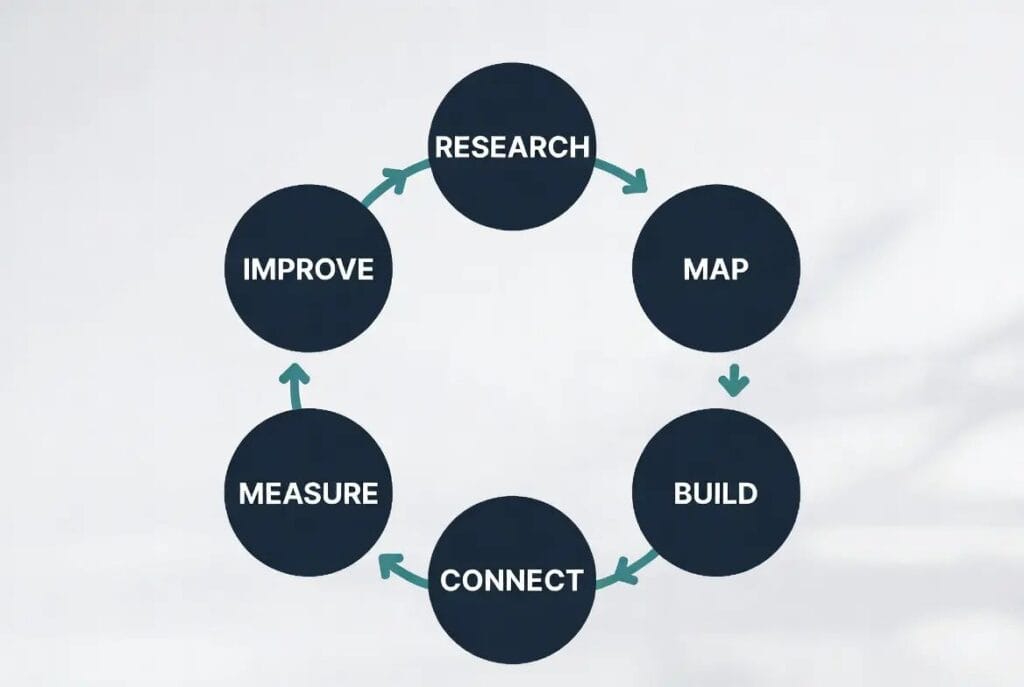
Most people treat these as separate, unrelated tasks. I treat them as one repeating cycle.
Step 1 — Research the Entire Topic
The lesson: researching one article at a time is how you end up with disconnected content. I used to research a single keyword, write the piece, and move on with zero memory of what I’d already covered.
Before I even start drafting, I organize everything inside Claude Projects so the research, competitor notes, and topic map stay in one place.
Claude earns its place at this stage because it can hold dozens of data points at once without getting attached to any single one. I can’t scan forty competitor articles and cleanly separate a genuine gap from something everyone already covers — Claude sorts that faster than I can, even though I also assume Claude can be wrong, which is why I follow the same fact-checking workflow before anything gets published.
Before building a complete topical map, I usually found 6–8 article ideas per topic. Now my research process consistently uncovers 25–40 connected ideas, many coming from Reddit, Google’s People Also Ask, competitor gaps, and Claude’s semantic grouping.
Takeaway: research the topic, not the keyword. The keyword is just the entry point.
Step 2 — Build One Complete Topic Map
The lesson: a content calendar is not a topic map. I had a spreadsheet of forty article titles for over a year, and the connections between them were accidental, not designed.
A topic map is different. It’s one pillar, a defined set of spokes underneath it, and an explicit reason each spoke exists. Before I write anything now, I lay out the full cluster with Claude: what the pillar covers at a high level, what each spoke covers in depth, and where the natural links between them actually are.
| Content Type | Purpose | Depth |
|---|---|---|
| Pillar | Broad overview, connects the whole cluster | Wide, not deep |
| Cluster / Spoke | One specific subtopic, answers one search intent | Narrow, deep |
| Supporting | Answers a small question that doesn’t deserve its own page | Minimal, often FAQ-level |
Seeing the whole map at once is what stops me from writing three articles that quietly compete with each other for the same search intent.
This planning stage also prevents many of the common Claude writing mistakes that happen when articles are created independently.
Takeaway: map the cluster before you write the first word of any article inside it.
Step 3 — Use Claude as a System
The lesson: a single Claude chat with no memory of my voice or my project is a worse writer than a system that already knows both.
I stopped starting from a blank prompt every time. Every article now runs through a Claude Project loaded with my actual voice samples, my topic map, and a brief specific to that article — outline, word count, and forbidden words already defined, not re-explained from scratch.
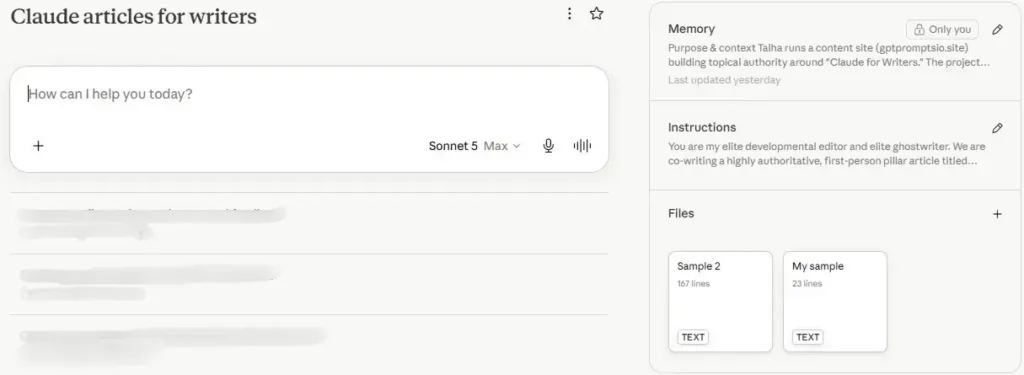
This is the difference between Claude guessing at my voice and Claude matching it. The project holds context I’d otherwise have to re-explain in every new chat.
Takeaway: stop prompting from scratch. Build the project once, reuse it for every article in the cluster.
Step 4 — Connect Every Article Together
The lesson: internal links added after publishing feel forced, and readers can tell.
Now the links get built into the outline before I write a word. If the topic map shows a spoke needs to reference my Claude Artifacts guide or my SEO writing workflow, that reference gets written into the actual argument of the article — not bolted on as a “related posts” afterthought.
For blog posts that need a more natural structure, I follow the same process from my AI workflow for human-like blog posts.
Claude is useful here because it can hold the entire cluster’s structure while I’m focused on the sentence in front of me. It’s not always right. Sometimes it suggests a link that’s technically related but contextually clunky, and I cut those.
Takeaway: an internal link should strengthen the sentence it’s in. If it doesn’t, it isn’t ready yet.
Step 5 — Measure, Improve and Repeat
The lesson: publishing isn’t the finish line. I used to treat “published” as “done” and then wonder why some articles never gained traction while others took off.
Every article gets checked against real performance now — impressions, clicks, ranking position, where readers drop off. Every month I review impressions, clicks, average position, new keyword rankings, and internal linking opportunities. Every quarter I perform a complete cluster audit. What I learn feeds straight back into Step 1. A spoke that underperforms usually means the research missed an angle. It rarely means the writing was bad.
High-performing pages get expanded, while weaker ones go through the same process I use when updating old blog posts with Claude.
Claude doesn’t measure any of this for me. It has no access to my actual Search Console data unless I bring it in myself, and I’m not handing interpretation of real performance numbers to a model that can’t verify them. This step stays entirely mine.
Takeaway: treat every published article as a hypothesis, not a finished product.
What Claude Still Can’t Do
This system only works because I stopped expecting Claude to do the whole job.
Hallucinations. Claude will state a fact with total confidence that isn’t true. Every statistic and every claim about a tool or feature gets checked before it goes near my site.
Context Rot. Long sessions drift. Claude forgets earlier instructions, starts sounding less like me the longer a conversation runs, and occasionally contradicts something it said a few prompts earlier. I’ve learned to catch the drift early and restart instead of patching a conversation that’s already lost the thread.
Weak internal linking judgment. Claude can spot a topical connection. It can’t always tell when that connection is contextually awkward. I override this constantly.
Generic wording. Left unchecked, Claude reaches for the same handful of words every AI model reaches for. My voice profile fights this — it doesn’t eliminate it. I still cut words on every draft.
Outdated information. Claude’s training has a cutoff. Anything about current tools, pricing, or features gets verified separately, every time.
None of this makes Claude useless. It makes it exactly what it is — an assistant that needs a system built around it, not a replacement for having one.
My Biggest Lessons
I over-researched before I under-structured. Endless research feels productive. It isn’t, without a map to put it into.
I used to write the pillar first. That’s backwards. Now I map the entire cluster first and write the pillar last, once I actually know everything it needs to connect to.
I trusted Claude’s first draft too much, early on. One of my early Claude drafts confidently described a feature that Anthropic had already changed. I caught it before publishing, but it reminded me that sounding confident isn’t the same as being correct. Since then, I manually verify every factual claim.
I under-invested in my Voice Profile for months. Every article before I built one properly needed more editing than it should have.
If I were starting this system today, I’d build the topic map and the Voice Profile in the same week — before writing a single article.
FAQ
Can Claude build topical authority by itself? No. It can execute a system I design, but it can’t decide what my audience actually needs or judge whether the final piece is actually good. Topical authority is a strategy decision before it’s a writing task.
Which Claude features are most useful? Projects, for holding my voice and context across every article without re-explaining myself each time. Artifacts, for drafting and revising in place instead of regenerating from scratch every time I want a change.
What’s the biggest mistake people make? Treating Claude as a one-off prompt instead of a system. Asking for “an article about X” produces generic content. Feeding it a topic map, a voice profile, and a specific brief produces something closer to what I’d actually publish.
Conclusion
None of this works because Claude is smart. It works because I stopped treating every article as its own island and started treating my site as one system with a repeatable process behind it.
The framework is simple on purpose: Research, Map, Build, Connect, Measure, Improve. What’s hard is doing it consistently, article after article, instead of reaching for whatever feels easiest that day.
Today this system powers my entire Claude content cluster. Every new article starts with the same workflow instead of a blank page, making expansion much faster while keeping the whole cluster connected.
If you’re still publishing disconnected articles and wondering why nothing compounds, this is the fix. Not a better prompt. A better system.