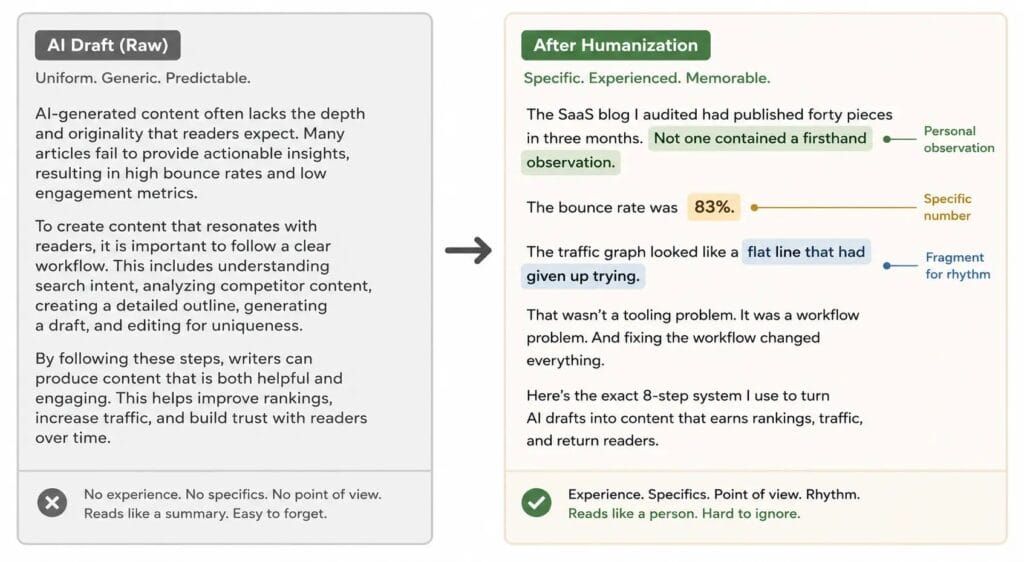
I audited a content site last year that had published forty AI-generated articles in three months. Rankings were flat. Bounce rate was sitting at eighty-three percent. The writer thought the problem was Claude.
It wasn’t Claude.
Every article followed the same broken workflow: paste in a keyword, generate a draft, light edit, publish. The output was technically accurate, grammatically clean, and completely forgettable. The kind of content that earns one read and zero return visits.
That’s not an AI problem. It’s a workflow problem.
When I say “human-like blog posts,” I’m not talking about content that simply passes an AI detector.
I’m talking about content that demonstrates firsthand experience, original insights, authentic voice, natural language, and editorial judgment. The workflow below is designed to produce those outcomes consistently. It combines AI-assisted writing with human oversight, content quality checks, fact-checking, and information gain so the final article feels like it was written by someone who has actually done the work.
Here’s the AI writing workflow I use for every long-form piece. Eight steps. None optional.
My AI Writing Workflow at a Glance
- Search intent analysis — understand what the reader actually needs
- SERP gap analysis — map what competitors cover and what they miss
- Information gain brief — document my original observations before drafting
- Structured outline — build the architecture before AI touches anything
- Draft generation in Claude — expand the brief, not replace my thinking
- Humanization layers — seven targeted edits that reinsert the human element
- SEO and AI search optimization — traditional SERP plus AI Overviews
- Final editorial review — human judgment before publish, every time
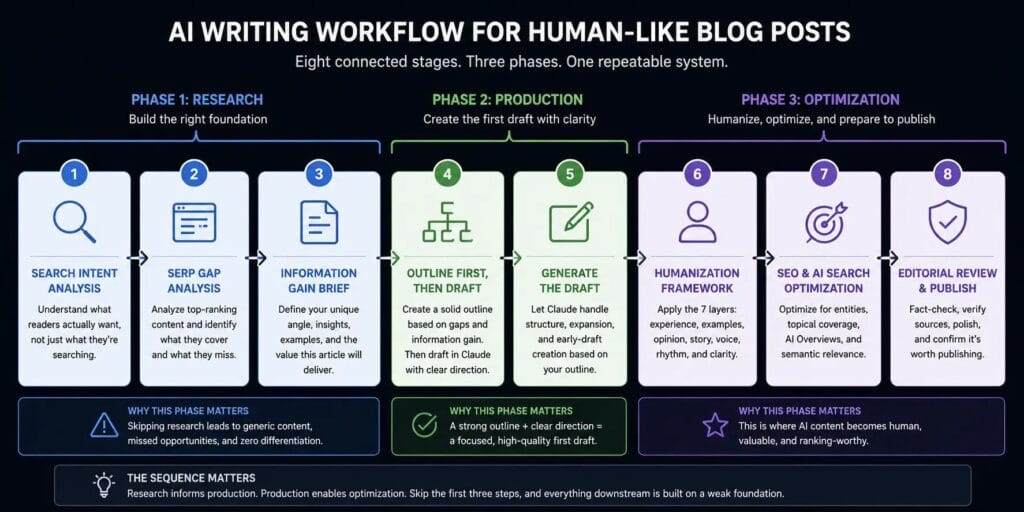
Most AI content workflows start at Step 5. That’s where the forgettable content comes from.
Why Most AI Blog Posts Still Sound Like AI
The problem isn’t sentence quality. It’s what’s missing.
I’ve reviewed enough AI drafts to recognize the failure patterns immediately. Here’s what shows up every time:
No firsthand experience. The article explains concepts it has never tested. It describes categories of evidence without naming a single specific example from real work.
No opinions. AI drafts are relentlessly balanced. Every claim gets softened with “however” or “it depends.” An article that agrees with everyone convinces no one.
Predictable structure. Introduction, three to five equal-weight sections, conclusion with a summary that restates the introduction. The skeleton is so familiar that readers stop engaging before they’ve finished the first scroll.
No information gain. The article covers exactly what the top three competitors cover, in roughly the same order, at roughly the same depth. There is no reason to read it over any of the others.
Published first drafts. The fastest way to spot unfixed AI content is sentence length — every sentence running fifteen to twenty words, every paragraph cleanly symmetrical, no variation in rhythm anywhere.
Here’s what the difference looks like in practice.
AI draft: “AI-generated content often lacks the depth and originality that readers expect. Many articles fail to provide actionable insights, resulting in high bounce rates and low engagement metrics.”
After humanization: “While reviewing AI-generated articles in my niche, I noticed the same pattern repeatedly. The content was accurate and well-structured, but it lacked firsthand observations, original insights, and a distinct point of view. Everything felt polished. Very little felt memorable.”
Same claim. One reads like a report. The other reads like a person who was actually there.
Step 1: Search Intent and SERP Gap Analysis
Before I open Claude, I understand what the reader actually needs.
This is different from keyword research. Keyword research tells me what people search. Search intent analysis tells me why they’re searching and what format will satisfy that need. A query like “AI workflow for human-like blog posts” signals procedural intent — the reader wants a repeatable system, not a philosophical overview of AI capabilities.
Then I run a SERP gap analysis against the top five results. Two questions: what do they all cover, and what do they all miss?
On this specific query, every competitor article I reviewed explains workflow stages. Almost none explain why the stages are ordered the way they are, or what actually breaks when you skip one. A writer can follow those steps exactly and still produce forgettable content because they don’t understand the dependencies between them.
That’s the content gap. And it’s almost always about reasoning, not facts. Competitors document what to do. The opportunity is explaining why — specifically enough that the reader trusts you’ve done it yourself.
Identifying that gap before drafting is the difference between adding another article to an already-covered topic and writing the one that earns the click.
Step 2: The Information Gain Brief
This is the most skipped step in every AI writing workflow guide I’ve reviewed. It’s also where most of the quality gap between forgettable content and content worth ranking actually lives.
An information gain brief is not a content brief. A content brief tells Claude what to cover. An information gain brief captures what I know that competitors don’t — before Claude writes a single sentence.
Here’s what mine includes:
- What competitors already cover — so I don’t repeat it
- Competitor gaps — the actual SERP opportunity
- My firsthand observations — patterns from real projects, not generalizations
- Original examples — specific and documented, not hypothetical placeholders
- Contrarian takes — where I disagree with standard advice and can back it up
When Claude drafts from this brief, the output contains original insights because I loaded them first. Claude organized and expanded my thinking. It didn’t generate it from scratch.
That distinction is the entire difference between content with genuine topical authority and content that merely looks authoritative in its formatting. One is built on your experience. The other is built on averages.
Step 3: Outline First, Then Draft in Claude
Structure before AI. Always.
I build the outline before Claude touches anything. This forces me to make the editorial decisions — what gets a section, what gets cut, what the logical sequence is — before the AI introduces its own organizational defaults.
Once the outline is locked, I open Claude Projects. Projects maintain persistent context across sessions — my voice profile, style references, and information gain brief stay loaded. I’m not re-explaining my setup from scratch every session. If you haven’t configured this, my guide on [How to Set Up Claude Projects for Writers] covers the exact setup.
Claude’s job here is narrow: expand the outline, incorporate the brief, produce a readable first draft. My job is everything before and after.
First drafts are never publishable. That’s the design, not a limitation.
Step 4: The Humanization Framework
This is the most important step in the workflow. Most AI writing guides compress it into one vague instruction about editing for voice. That’s not enough.
A Claude draft comes out clean, structured, and lifeless. It reads like someone who knows the topic in theory but hasn’t done the work. Seven targeted edits fix that.
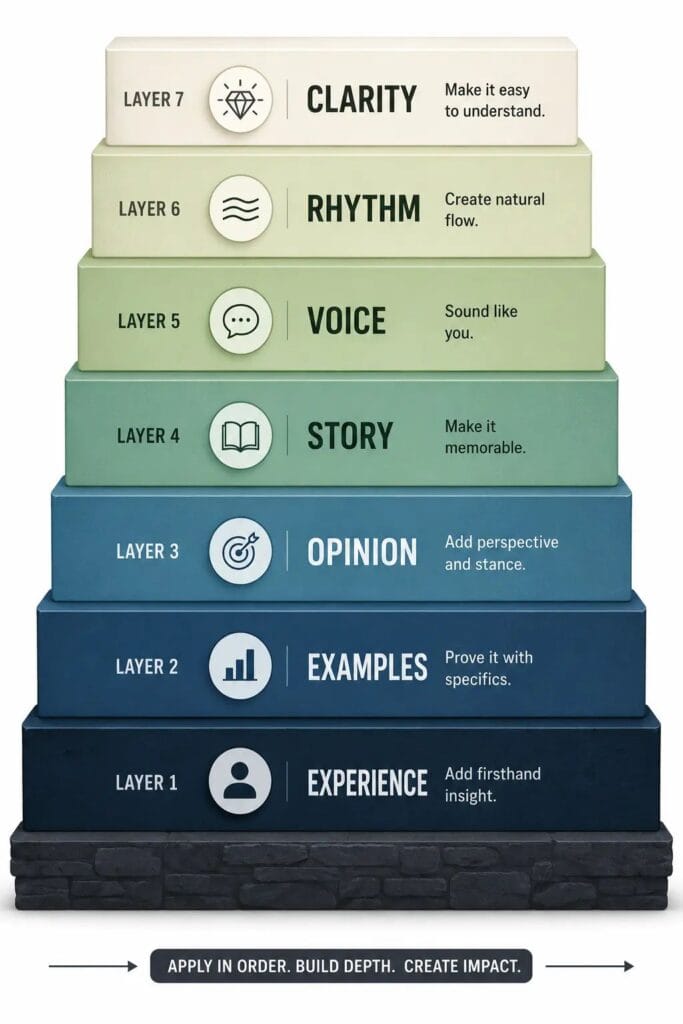
Layer 1 — Experience: Add a specific observation from a real project. Not “many writers struggle with this” — name the scenario, the client, what happened, what it cost.
Layer 2 — Examples: Replace every generic statement with a concrete specific. Not “AI content often lacks depth” — the actual audit, the actual blog, the actual eighty-three percent bounce rate.
Layer 3 — Opinion: State your perspective directly. Not “there are two schools of thought.” What do you think, and why? Skip this layer and the article reads like curated research with no one behind it.
Layer 4 — Story: One micro-story per major section. One moment, one point it proves. This article’s opening is a working example.
Layer 5 — Voice: Run the draft against your Voice Profile. Find the AI patterns — passive constructions, hedging language, transitions like “Furthermore” and “It is worth noting that.” Cut them. This is where your banned vocabulary list does its actual job.
Layer 6 — Rhythm: Read it aloud. Where the pacing drags, break the paragraph. Where it feels choppy, let a sentence run longer. AI drafts trend toward consistent sentence length. Human writing doesn’t.
Layer 7 — Clarity: Remove every sentence that exists only to soften another sentence. If a point is worth making, make it directly and move on.
Layer 3 is the most commonly skipped. Writers add experience and examples but leave their perspective out entirely. The result reads like a well-formatted summary — technically thorough, entirely unconvincing.
Voice training happens before drafting. Humanization layers happen after. My [How to Train Claude to Write in Your Voice: My 4-Step Voice Profile Framework] covers the pre-draft foundation.
Step 5: SEO and AI Search Optimization
Standard on-page optimization still applies: primary keyword in the H1, semantic terms distributed through the body, internal linking to related cluster articles for contextual relevance. That baseline hasn’t changed.
What most AI workflow guides skip entirely is Answer Engine Optimization.
Google’s AI Overviews pull from passages that answer specific questions with precision. The articles cited aren’t always the highest-authority domains — they’re the ones with clearly structured, semantically accurate passages that match query intent directly. Entity optimization matters more here than keyword density. I write to establish clear relationships between concepts: search intent connects to content briefs, information gain connects to topical authority, topical authority connects to search visibility.
These aren’t SEO terms to scatter through the copy. They’re the logical structure of a useful article. Write for those relationships and the optimization follows naturally.
The broader operational framework behind using Claude across a professional AI-assisted writing workflow is covered in my [Claude for Writers: The 2026 Operational Guide].
How Claude Projects and Artifacts Fit
Claude Projects handles the pre-draft layer: voice profile storage, brief persistence, research organization. Every article in a content cluster lives inside one Project. Context doesn’t reset between sessions.
Claude Artifacts handles the post-draft layer: revision tracking, draft version comparison, and running humanization layers in documented passes rather than one undifferentiated free-form edit.
My [How to Use Claude Artifacts for Writing] covers the full production workflow.
How This Workflow Looks in Practice
This article itself followed the workflow I’m describing.
I started with search intent analysis to understand what readers actually wanted when searching for “AI workflow for human-like blog posts.”
Next, I reviewed the top-ranking articles and documented their common patterns. Most covered research, outlining, drafting, and editing. Very few discussed information gain, humanization frameworks, entity relationships, or AI search optimization.
Those gaps shaped the outline.
Before drafting, I created an information gain brief containing my observations, examples, and perspectives on where most AI writing workflows fail.
Only then did I begin drafting with Claude.
The first draft handled structure and expansion. The editing phase focused on adding experience, strengthening opinions, improving reader engagement, refining the voice, and increasing semantic relevance.
In other words, Claude helped produce the draft. The workflow produced the final article.
Common Mistakes That Break This Workflow
- Opening Claude before completing Steps 1–3
- Skipping the information gain brief and loading nothing original
- Treating draft generation as the final stage
- Compressing seven humanization layers into a single light-touch edit
- Adding content to hit a word count instead of cutting what doesn’t earn its place
- Asking Claude to approximate a writing voice you haven’t documented
That last mistake produces a recognizable failure mode. The output sounds approximately like you — the way a cover band sounds approximately like the original. All the notes are there. Something is still off. The reader can feel it even if they can’t name it.
Final Thoughts
The goal was never AI-generated content.
The goal is humanized AI content that combines AI efficiency with human expertise, editorial judgment, original insights, and authentic voice.
I ran an earlier version of this workflow on a struggling SaaS blog. We cut their publishing output in half and focused entirely on information gain and humanization quality. Organic traffic tripled in four months. Publishing less, written better, built on original insights — that’s what the results rewarded.
AI is the production tool. Your firsthand experience, your editorial judgment, your original insights — that’s what makes the content worth reading.
Run the eight steps in order. Build the information gain brief before drafting. Apply every humanization layer before publishing.
AI writes the first draft. You decide if it’s publishable.