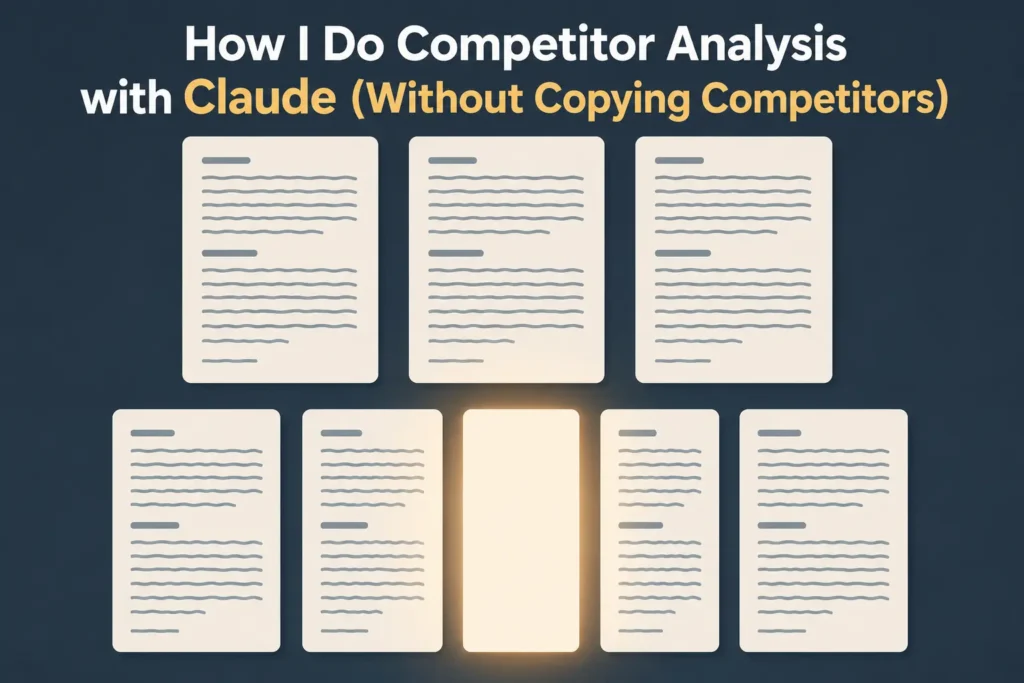
Last month I pulled up the top eight results for a keyword I was targeting and read every article back to back. By article four, I could predict article five’s headers before I even scrolled down to check. That’s not competition that’s the same article wearing eight different bylines.
Most competitor analysis is competitor imitation with extra steps. You read what’s ranking, copy the structure, swap in your own examples, and publish something that looks like everything else already on page one. Google notices. So do readers.
I use Claude for competitor analysis too, but not to copy anyone’s structure. I use it to find the article nobody wrote yet.
Competitor analysis isn’t about finding what to copy. It’s about finding what’s missing.
My Competitor Analysis Workflow With Claude
I break this into three steps: build the inventory, map the gaps, then validate before I write a single word of the brief.
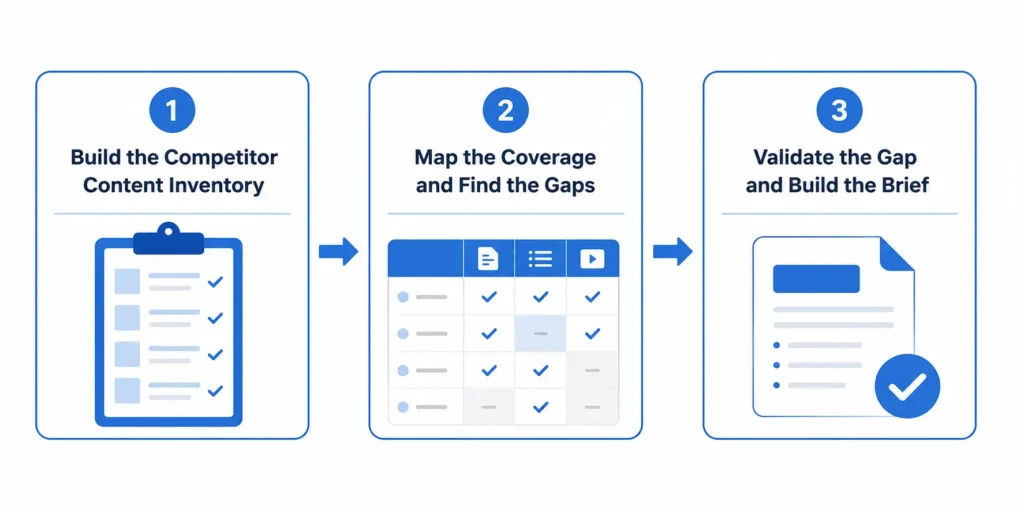
Step 1: Build the Competitor Content Inventory
I manually collect the top-ranking pages for my target keyword and topic, then feed the raw text into a Claude Project. The “manually” part matters: Claude doesn’t crawl live search results and can’t check today’s rankings on its own. If I don’t feed it current pages myself, it works from outdated assumptions about what’s ranking — garbage in, garbage out, except here the garbage is stale competitive intelligence.
So I pull the ranking URLs myself, usually [5–8] of them, plus a quick Google Search Console check to see what I already rank for on adjacent terms. I paste the raw article text into my Claude Project, one document per competitor, and I keep a single Project per site so this content inventory sits inside my normal editorial workflow instead of a chat I’ll never find again. (If you haven’t set Claude up for content work yet, I cover that from the ground up in my Claude for Writers guide.)
Once I have the raw material, the real work starts: comparing it.
Step 2: Map the Coverage, Then Find What’s Missing
This is where Claude actually earns its place in the process. I ask it to build a coverage map across every competitor piece — an entity analysis alongside a subtopic comparison — so I can see the gaps at a glance instead of holding eight articles in my head at once. A gap you can’t see is a gap you can’t write about, and reading eight articles while mentally tracking what’s absent is exactly how you miss the real opportunity.
Here’s roughly what I ask Claude to build:
| Subtopic | Competitor A | Competitor B | Competitor C | My Draft |
|---|---|---|---|---|
| [Subtopic 1] | Covered | Covered | Not covered | ? |
| [Subtopic 2] | Covered | Not covered | Not covered | ? |
| [Subtopic 3] | Not covered | Not covered | Not covered | ? |
That bottom row is the interesting one — finding it isn’t luck, it’s the entire point of the exercise. Claude organizes this comparison, but it doesn’t decide which gap matters. That part’s mine: I check every apparent gap against actual search intent, not just absence. A subtopic nobody covers might be a real opportunity, or it might be uncovered because nobody searches for it at all.
The mistake that cost me time: I once handed Claude a stack of competitor articles and asked it to flag gaps. It came back with a long list, and I built an entire content brief around the “gap” that looked most unique. [X] hours of writing later, I checked search volume — nobody was searching for it, not close. Claude had correctly identified that no competitor covered the subtopic. It just had no way to tell me that was because there was no demand, not because everyone else had missed something valuable.
Now, before any gap becomes a brief, it has to survive this checklist:
- [ ] Does it show up in Search Console as a query I already get impressions for?
- [ ] Does it match real search intent — not just absence from competitor pages?
- [ ] Does it appear in People Also Ask or an AI Overview at all?
- [ ] Does it overlap with something I’ve already published in this topical cluster?
Claude compares. I validate. That order doesn’t flip.
Step 3: Validate the Gap, Then Build the Brief
A validated gap becomes a content brief, not just a note that says “nobody covers this.” A gap without direction isn’t a brief — it’s a diary entry.
For every gap that survives Step 2, I ask Claude to draft the brief: the angle, the subtopics to cover, the key entities, and where it fits into my broader content roadmap, including whether it overlaps something I’ve already published. That overlap check also shapes my internal linking, since it tells me how this piece should connect back to the rest of the topical authority cluster instead of competing with it.
I keep that brief as a Claude Artifact instead of a chat message, so it stays a living document while I refine it instead of something I have to hunt for in scroll later. (I’ve written separately about the mechanics of isolating gaps themselves in how I find content gaps with Claude — this piece is about the competitive research that feeds into that process, not a replacement for it.)
That’s the workflow end to end, but none of it works if I pretend Claude is doing the strategic thinking. It isn’t.
Why Most Competitor “Analysis” Is Just Competitor Copying
Most competitor analysis stops at “what are they covering.” That’s an outline exercise, not analysis. It tells you what already exists — it doesn’t tell you what’s missing, and it doesn’t tell you what would actually earn a ranking instead of just matching one.
Here’s why that matters: every article built this way adds to the noise instead of the signal. This isn’t just a keyword-matching problem anymore — semantic SEO means Google is already mapping entities and relationships across every page on that SERP, so matching the same subtopics just confirms what it already knows. If your new piece covers the same ground as the five articles already ranking, you’ve given Google, and any AI Overview pulling from that SERP, zero reason to feature you over them. You’ve built a sixth version of the same page.
So I stopped asking “what are competitors covering” and started asking “what are they missing.” That shift changed what competitor research means in my process. It’s not a content inventory — it’s a content gap analysis, hunting for the missing perspective instead of the popular one.
The mistake that taught me this: early on, I built what I called a “competitive content audit,” which was really just a shared outline of every H2 across the top ten results. I published articles that matched the SERP structure almost exactly, and they ranked page two every time. [X] articles in, I noticed the pattern: I wasn’t adding information gain. I was adding volume.
Here’s the workflow I actually use now — built around finding gaps, not mirroring structure.
Where Claude Gets This Wrong (And How I Compensate)
Claude is excellent at comparison and organization. It’s not reliable at deciding what actually matters to my business, and I’ve learned not to ask it to. Here’s where it consistently falls short, and what I do about each one:
- Hallucinated specifics. Claude occasionally flags a subtopic as “missing” from an article that actually mentions it in passing. I spot-check the source text before I trust any gap. (More on this in how I fact-check Claude before publishing anything.)
- Outdated context. Claude doesn’t know this week’s SERP or this month’s algorithm shift. I feed it fresh competitor text every time and never reuse last quarter’s comparison for a new brief.
- Duplicate suggestions. Left alone, Claude will sometimes recommend a “gap” that’s really just a reworded version of something I’ve already published. I check every new brief against my own site before I approve it.
- Weak prioritization. Claude can hand me ten gaps with equal confidence, but it has no idea which one matters to my traffic goals this quarter. That call is mine.
- No business context. Claude doesn’t know which topic ties to something I’m trying to sell versus something that’s purely informational, so I add that filter myself, every time.
Claude Finds the Gaps. I Decide Which Ones Matter.
None of this makes Claude a strategist. It makes it a fast research assistant that never gets tired of reading eight competitor articles in a row.
The actual strategy is still mine — which gap is worth writing into, which angle earns the click, which piece protects the cluster instead of competing with my own content. Claude can tell me what’s missing from a page. It can’t tell me what’s missing from my business.
That’s the difference between asking Claude for article ideas and doing this properly. One gives you a list. The other gives you a reason to publish.