I almost published a paragraph that sounded completely correct. The tone was confident. The structure was clean. Every sentence read like something I’d already checked myself.
Then I went looking for the source it was supposedly built on. I couldn’t find anything that actually said what the paragraph claimed.
Nothing about that draft looked wrong. That’s what stopped me. A sloppy sentence gets caught by any editor. A polished one can walk straight into a published article with my byline on it.
That near miss didn’t make me trust Claude less. It made me realize my prompts weren’t the problem. My publishing process was.
Quick Answer
I never publish anything Claude writes without running it through a full review first. Not because Claude is unreliable — because editorial responsibility belongs to me, not the tool I used. Every article, no exceptions, passes through the same process before it goes live: highlight the claims, check them against primary sources, confirm they’re current, then edit for accuracy before I edit for style.
Why I Started Fact-Checking Everything
Polished writing creates confidence. That’s the whole problem.
When a paragraph reads smoothly, sounds authoritative, and uses the right terminology, my brain treats it as verified information. It isn’t. Confidence is a writing quality, not a fact-checking result. Claude is good enough at sounding right that I stopped trusting my own gut reaction as a quality signal.
Good writing can absolutely contain mistakes. Bad writing gets caught immediately because it looks suspicious. Good writing gets published because it doesn’t.
This isn’t really a piece about hallucinations, even though that’s the word most people reach for. It’s about what happens after Claude hands me a draft — accurate or not — and it’s one piece of the bigger system I lay out in Claude for Writers: The 2026 Operational Guide.
The Workflow, Step by Step
Every step here exists because I skipped it at least once and got burned.
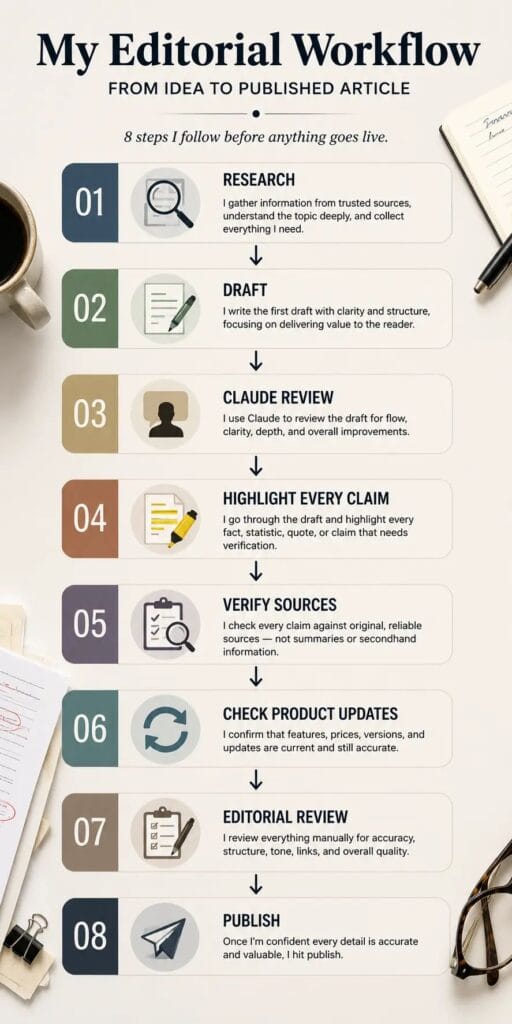
No single step replaces another. Research finds the information. Claude review shapes the language. Verification confirms the facts are true. Skip one and the whole chain weakens, not just that link.
Step 1: Highlight Every Verifiable Claim
I don’t verify paragraphs. I verify claims.
Before anything else, I go through the draft and flag every sentence that makes a checkable statement: a statistic, a release date, a product feature, a price, a quote, a technical claim.
This step alone saves hours. Most of a draft is analysis, opinion, or narrative — none of that needs a source. Isolating the sentences that actually claim something cuts an entire article down to a short, specific list.
Step 2: Verify Original Sources
Once I know what needs checking, I go to the source — not a summary of the source.
Official documentation → Official announcements → Research papers → Trusted publications → Everything else
I work down that list in order and stop as soon as I find a real answer. A blog post explaining a company’s pricing change isn’t the same as that company’s own pricing page, and summaries lose precision every time they get rewritten.
Step 3: Check Whether Product Information Is Still Current
AI tools change faster than almost anything else I write about, and that’s exactly where outdated information hides best.
Features get renamed. Interfaces get redesigned. A plan that existed when a model’s training data was compiled might not exist by the time someone reads the article months later.
I treat every product-specific claim as expired until I confirm it’s current. It’s the same instinct behind How I Use Claude to Update Old Blog Posts Faster — content doesn’t stay accurate just because it stays published.
Step 4: Separate Facts From Opinions
Facts require evidence. Opinions require experience. Claude is useful for organizing both, but I decide which is which.
A verified product announcement is a fact. My take on whether that feature is actually worth using is an opinion. Both belong in my articles. Neither should be mistaken for the other.
When I edit a draft, I mark every sentence as one or the other. If a claim reads like a fact but I can’t back it with a source, I either rewrite it as an opinion or cut it completely.
Step 5: Replace Weak Claims Before Readers See Them
Some sentences aren’t wrong. They’re just empty.
I cut generic superlatives — “the best tool,” “incredibly powerful” — because they claim everything and prove nothing. I cut vague statements that sound specific but aren’t, and absolute claims like “always” and “never” unless I can actually stand behind them.
Then I replace what I cut with something specific: a real workflow step, a real constraint, a real number if I have one. Specific and modest beats impressive and unsupported every time.
Weak claims don’t just reduce trust—they also make articles less helpful for search. That’s why the same editorial standards I use here also shape my workflow in Claude for SEO Writing: My Complete Workflow for Creating Search-Optimized Content.
Step 6: Complete a Human Editorial Review
Claude finishes the editing. I decide whether the article is ready to publish. That decision doesn’t belong to a tool, and I don’t outsource it.
Before anything goes live, I run through the same checklist every time:
- Facts and sources
- Internal links
- Dates and version numbers
- Examples and claims
- Recommendations
- Headings and flow
- Screenshots
- Formatting
- Overall reader clarity
If I can’t confidently defend every line on that list, the article waits.
What I Verify Before Publishing
| Content Element | How I Verify It |
|---|---|
| Statistics | Trace to the original data source, not a summary |
| Benchmarks | Confirm the test conditions match the claim |
| Dates | Cross-check against official release notes |
| Feature descriptions | Compare against current product documentation, not memory |
| Pricing | Check the live pricing page, not cached memory |
| Product names | Match the exact current name and capitalization |
| Screenshots | Recreate them right before publishing |
| Quotes | Trace to the primary source, never a secondhand summary |
| Internal links | Click every one before the article goes live |
| External sources | Confirm the page still exists and still says what I think |
Mistakes I Used to Make
I’ve written before about the broader mistakes writers make with Claude in Common Claude Mistakes Writers Make. These four are specific to fact-checking — the ones that actually let something wrong slip through before I caught it.
I trusted polished writing too quickly. If a paragraph read well, I assumed it was accurate — writing quality and factual accuracy are different skills. Good writing gets more scrutiny from me now, not less.
I leaned on secondary sources. A confident summary felt close enough to the original — it wasn’t. Summaries drop the caveats and sample sizes that change what a claim means. Primary sources only, now.
I assumed Claude understood recent product updates. It doesn’t, reliably — training data has a cutoff and products change monthly. Anything it says about current features is now a claim I verify, not a fact I trust.
I relied on memory instead of checking. I “knew” something from writing about the topic before, so I skipped the source. Memory drifts. Facts change. If I can’t point to where I confirmed it, I don’t treat it as confirmed.
What I Never Ask Claude to Verify
Some categories don’t belong in this process, because Claude checking its own claim about them means nothing.
I never ask Claude to verify legal information, medical information, financial advice, breaking news, new product announcements, or benchmark numbers. Each needs a current, human-accountable source — a lawyer, a regulator, a live press release — not a language model checking its own homework.
Editorial Principles I Follow
A few rules guide every article before it publishes, regardless of topic or deadline:
- Readers trust my byline, not my prompt history. That trust is mine to protect.
- Original sources beat AI summaries. No exceptions.
- Evidence beats confidence. A claim that sounds right still needs a source.
- If I can’t verify it, I remove it. No exceptions, even for claims I’d like to keep.
- Speed never outranks trust. A late article beats a wrong one.
- Claude improves drafts. I approve publishing. That division of labor doesn’t move.
Before vs. After My Review Process
The shift was just a change in what comes first.
| Old Workflow | Current Workflow |
|---|---|
| Trust polished output | Highlight factual claims |
| Accept summaries | Check original sources |
| Edit wording first | Verify facts first |
| Publish after editing | Publish after editorial review |
Who This Workflow Helps
This shows up differently depending on the type of writing:
| Who | Biggest Benefit |
|---|---|
| Bloggers | Fewer embarrassing corrections after publishing |
| SEO Writers | Claims that hold up when readers double-check them |
| Freelancers | A process clients can see and trust |
| Editors | A faster way to spot what needs real scrutiny |
| Content Marketers | Fewer retractions that damage brand credibility |
| Technical Writers | Confidence that product details are still accurate |
None of this exists to catch Claude being wrong. Claude is a tool, and tools don’t carry bylines.
The longer I’ve used it, the less fact-checking feels like error correction and the more it feels like reader protection. Readers can’t see which sentence came from a prompt. They see one name at the top of the page.
That’s the only reason every claim in every article still passes through me before I press Publish.