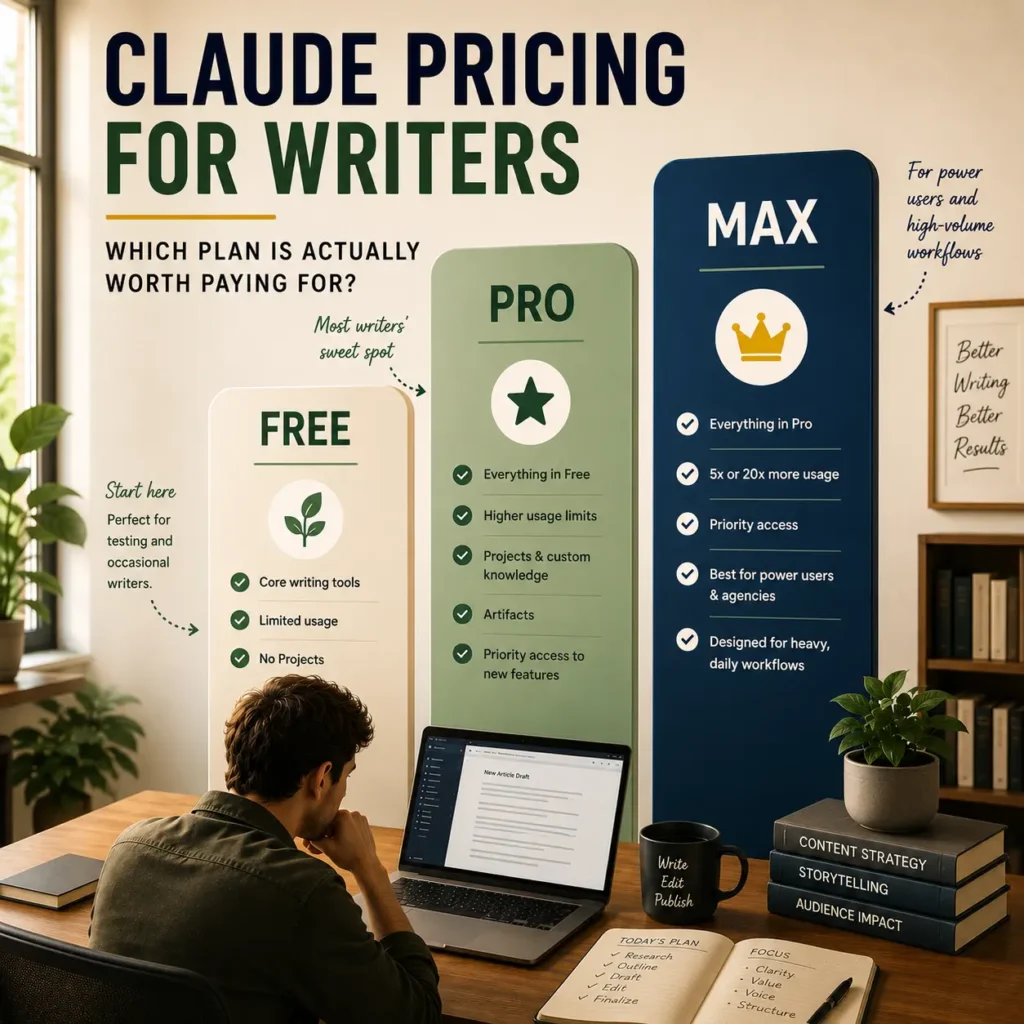
I pay for Claude. I also spent longer than I should have trying to talk myself out of it — running everything through the free tier and calling it frugal. It wasn’t frugal. It was slow. I kept hitting my usage budget mid-draft, losing my thread, and rebuilding context in a fresh chat. That cost me more time than the subscription would have cost me in money.
That’s the problem with most “which Claude plan should I buy” articles. They compare specs — usage limits, context windows, model names — without asking what your actual writing workflow looks like. A freelancer juggling four client voices needs something different than a novelist living inside one 100,000-word manuscript. A blogger posting twice a month doesn’t need what an agency running six writers off the same brand guidelines needs.
So here’s the breakdown: plan by plan, then writer type by writer type, with the trade-offs left in instead of smoothed over.
If you haven’t set Claude up for writing work yet, Claude for Writers: The 2026 Operational Guide covers the basics this piece assumes you already know.
Do You Even Need to Pay for Claude as a Writer?
Short answer: not right away. The free tier is enough to find out whether Claude fits how you write before you spend anything.
Claude Free runs Sonnet — the same model that powers Pro by default, not a stripped-down version. What you don’t get is much room. Anthropic doesn’t publish an exact message count for any tier; usage works more like a rolling budget that resets every few hours, and how fast you burn through it depends on how long and complex your conversations get. There’s also no meaningful Projects access, so every new chat starts from zero — no style guide, no saved brand voice, nothing carried over.
Can you write a long-form article on Free? Technically. Practically, you’ll often hit your budget partway through a draft and have to pick the thread back up in a new conversation. The first time that happened to me, I was [PLACEHOLDER: roughly how many words] into a draft when it hit — the kind of interruption that makes “frugal” stop feeling smart.
Free is the right call if you’re posting occasionally, testing whether Claude fits your process, or writing short pieces that don’t need much back-and-forth. It’s the wrong call the moment writing becomes a real part of your income.
Is Claude Pro Worth It for Writers?
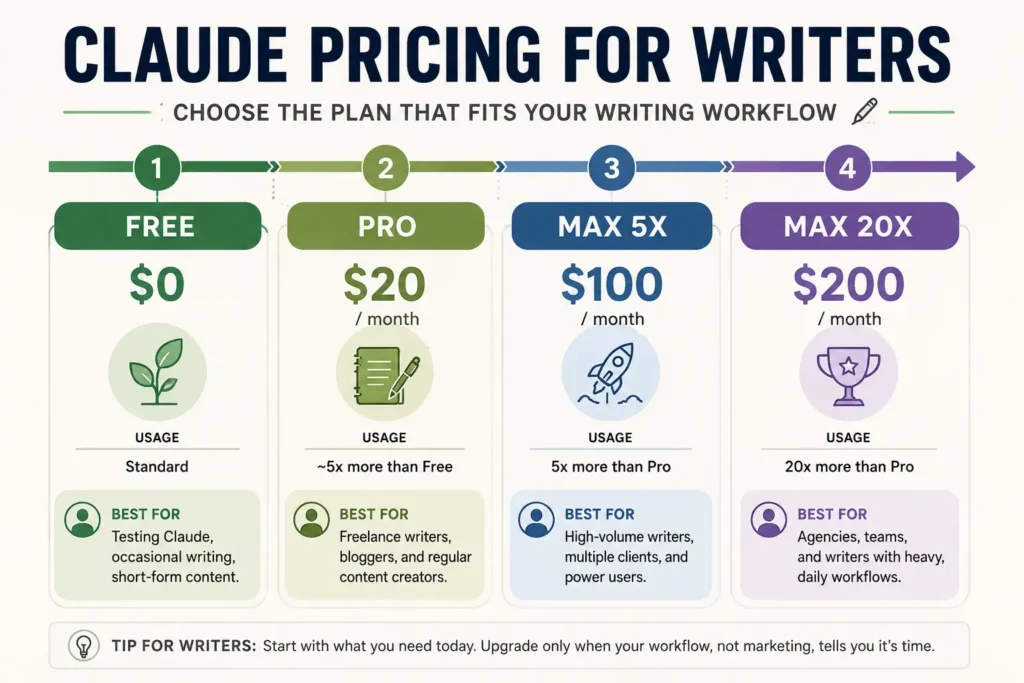
Quick answer: yes, for almost anyone who writes regularly. Pro runs $20 a month, or $17 if you pay annually, and it’s the plan that changes how you write, not just how much you can type before getting cut off.
The real value isn’t “more usage,” even though that matters too. It’s Projects. I keep my style guide, published samples, and brand voice notes inside a Project so I stop re-explaining myself in every new chat. How to Set Up Claude Projects for Writers walks through the setup if you haven’t done it yet.
Does Pro remove usage limits? No — and any article telling you it does is selling you something. Pro raises the ceiling substantially over Free. It doesn’t remove it, and Anthropic still won’t give you an exact number, because it isn’t a fixed number — length, model choice, and how hard a task makes Claude think all affect how fast you burn through it. When you do hit the wall, you can opt into pay-as-you-go “usage credits” to keep working at standard API rates instead of waiting out the reset. That overflow option exists specifically because the cap is real.
For a solo writer with regular client work or a consistent publishing schedule, Pro pays for itself inside your first serious project.
Is Claude Max Worth Paying For?
Straight answer: only if Pro is already the bottleneck. Not “would be nice to have more room.” Actually hitting the ceiling, on a normal week, not just a busy one.
Max comes in two tiers: 5x Pro’s usage for $100 a month, or 20x for $200. Both get you priority access to new models and features before everyone else. Neither makes the ceiling disappear — Max runs on the same rolling-budget system as Pro, just with a lot more room in it, and heavy daily use can still bump into the weekly side of that budget even on the 20x tier.
You’re a Max candidate if:
- You’re hitting Pro’s cap more than once or twice a week, not once a month
- You’re running several active client Projects and switching between them daily
- You’re inside one continuous long-manuscript session often enough that losing access mid-chapter actually hurts
You’re not a Max candidate if you write occasionally, publish a few times a month, or haven’t tested whether Pro’s ceiling is even a real problem yet. Save the money and find out first.
Max isn’t a “more serious writer” badge. It’s a fix for a specific bottleneck. If you haven’t hit that bottleneck, you’re not the target market yet.
For me, the moment that switched from theoretical to real looked like [PLACEHOLDER: the actual trigger — e.g. running back-to-back client Projects during a launch week].
What About the Claude API? Do Writers Need It?
Bottom line: almost never, for the writing itself. The API isn’t a writing plan. It’s infrastructure for people building tools, billed per token instead of a flat monthly fee, through a separate Console account.
That model makes sense if you or someone on your team is building custom tooling around Claude: an internal content pipeline, an automated brief generator, something with its own logic and interface. It makes no sense if you just want to open a chat and draft.
The API and a Claude subscription solve different problems. One is a tool for people who write. The other is infrastructure for people who build. Confusing the two is how writers end up pricing themselves into enterprise tools for a personal writing habit.
If your team is building that kind of tooling, prompt caching is worth knowing about — it cuts costs substantially when the same large context, like a style guide or a set of brand documents, gets reused across many calls. That’s a decision for whoever’s building the tool. It’s not something you need to think about as a writer choosing a plan.
Which Claude Plan Is Best for Freelance Writers?
Short answer: Pro, until client volume forces your hand. One Project per client keeps each brand voice separate without you re-pasting context every time you switch accounts.
The upgrade trigger isn’t a calendar date. It’s volume. When you’re running four or more active client Projects with overlapping deadlines, and switching between them starts to feel like the actual bottleneck in your day, that’s when Max earns its price. Before that point, you’re paying for headroom you’re not using.
Most freelance writers overestimate how fast they’ll hit that point. Test it on Pro before assuming you need more.
Which Claude Plan Is Best for SEO Writers and Content Marketers?
Quick answer: Pro at minimum, Max once you’re publishing at real volume. Content briefs, keyword notes, and internal linking maps all live comfortably inside a Project — How I Build Content Briefs with Claude covers how I structure that specific workflow.
The difference between SEO writing and general freelance work is throughput. Producing one or two pieces a week, Pro holds up fine. Running a content calendar with daily output across multiple sites or clients, you’ll feel Pro’s ceiling before you’ve gotten your money’s worth out of it — and that’s your signal to move up, not a reason to start there.
Is Claude Good for Authors Writing Long Manuscripts?
Yes, with one real limitation: the longer a single session runs, the less reliable it gets. This isn’t the context window shrinking — on a paid plan, the newest models hold up to a million tokens. It’s how much of that window is still usefully tracking your earlier chapters as the conversation grows.
I call this context rot: the same window, holding less usable story the further you push a single session. It doesn’t drain all at once. It thins out gradually — Claude starts flattening details it would have nailed earlier in the same conversation.
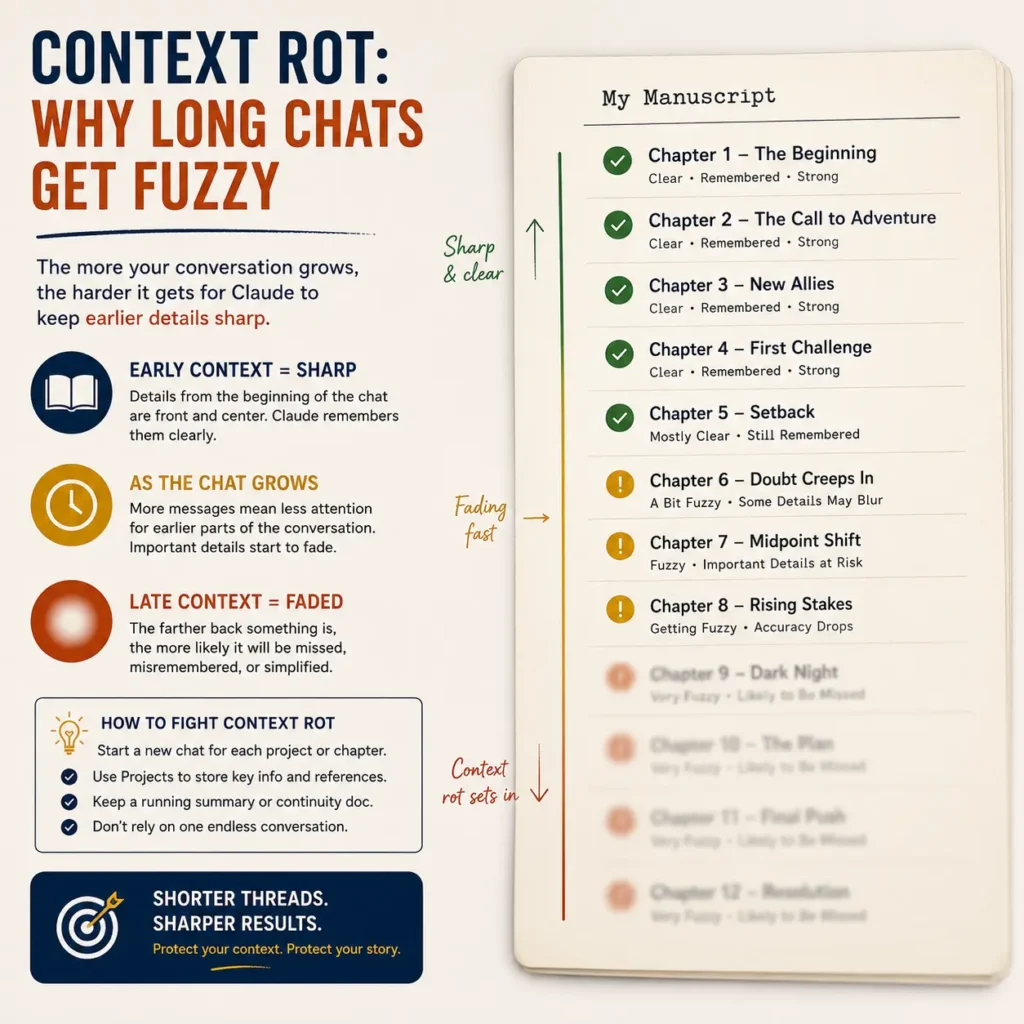
The fix isn’t a bigger plan. It’s a different workflow: chapter-level sessions instead of one marathon thread, plus a running continuity document inside your Project tracking character details, timeline, and voice. How to Train Claude to Write in Your Voice covers the voice half of that. The continuity half is closer to habit than software.
Any paid plan handles this reasonably. Free doesn’t hold enough usable context across a real writing session to make book-length work practical.
Which Claude Model Should Writers Actually Use?
Short answer: whatever your plan defaults to, most of the time. Free and Pro both default to Sonnet, which Anthropic built as its everyday, agentic-capable model — solid for the vast majority of drafting, editing, and brainstorming work. Opus, the higher-reasoning tier, is available on Pro with tighter caps and opens up fully on Max and above.
The practical pattern holds up across whatever versions are current when you’re reading this: a fast, lighter model handles outlines and quick edits, the default handles most actual drafting, and the top-tier model gets reserved for the highest-stakes single passes — a full developmental edit, a rewrite you only want to do once — since it eats more of your usage budget per response. Anthropic’s model lineup shifts often enough that memorizing version names wastes your attention; check Anthropic’s current model page before trusting anything specific I say here to still be current.
Model choice matters less than most writers think. Prompting matters more. The Anatomy of a Great Claude Prompt covers the structural side of that, if you’re getting inconsistent output regardless of which model you’re on.
Is Claude Better Value Than ChatGPT Plus?
Real answer: it depends which one you’ll actually open every day. Claude Pro and ChatGPT Plus both cost $20 a month. At the entry tier, price isn’t the deciding factor. Workflow fit is.
I write inside Claude’s Projects and Artifacts, and that combination fits how I organize client work and long documents. ChatGPT has its own equivalents, and writers who’ve built their process around those tools have no real reason to switch on value alone. Claude vs ChatGPT for Writers goes deeper on the actual workflow differences if you’re deciding between them from scratch.
Take “better value” with a grain of salt from anyone who only uses one of the two tools day to day. I use Claude daily. That’s a real bias, not a neutral benchmark.
When Should Writers Upgrade Their Claude Plan?
Quick answer: when the limit is the problem, not the price tag. Upgrading because a plan sounds more serious is how you end up paying for headroom you never touch.
Signs you’re ready to move from Free to Pro:
- You’re hitting your usage budget more than once a week
- You’re re-explaining your style or brand voice in every new chat
- You’re doing real long-form drafting, not just quick edits
Signs you’re ready to move from Pro to Max:
- You’re hitting Pro’s cap regularly, not occasionally
- You’re running multiple active Projects and feeling the switching cost
- Priority access during deadline weeks would save real time, not just annoyance
| Plan | Price | Usage | Best for |
|---|---|---|---|
| Free | $0 | Rolling budget, resets every few hours | Testing the tool, occasional short pieces |
| Pro | $20/mo ($17 annual) | Substantially higher than Free, still cappable under heavy Project use | Most regular working writers |
| Max 5x / 20x | $100/mo or $200/mo | 5x or 20x Pro’s usage, priority access | Multi-client freelancers, high-volume SEO writers, continuous long-manuscript sessions |
| Team | $25–$125/seat/mo | Shared across a group, admin controls | Agencies or studios running several writers on one account |
| API | Pay-per-use | Scales with usage, no flat cap | Building custom tools, not solo drafting |
Prices current as of this writing — Anthropic has adjusted usage limits more than once in 2026 already, so confirm the current numbers at claude.com/pricing before you commit.
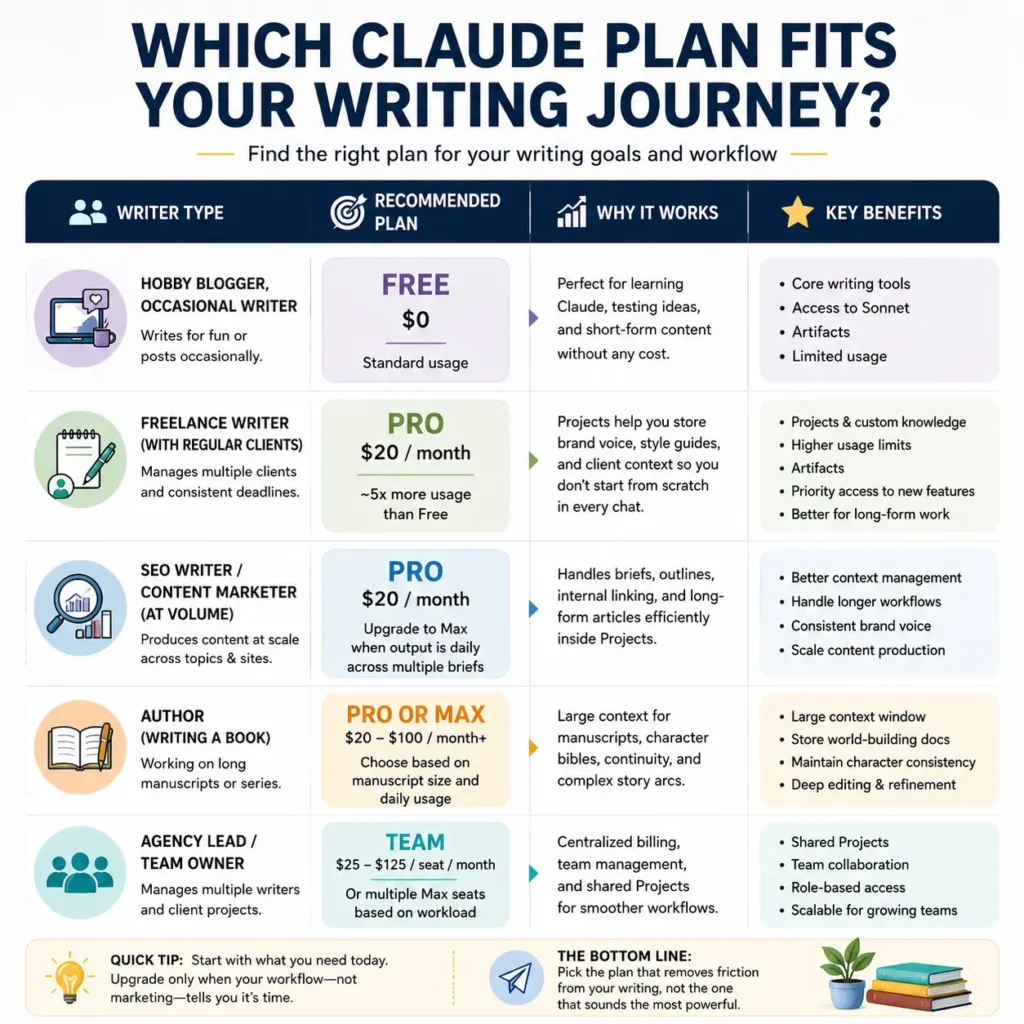
| Writer type | Recommended plan |
|---|---|
| Hobby blogger, occasional writer | Free — upgrade only once you actually hit the cap |
| Freelance writer with regular clients | Pro, Max once client volume forces it |
| SEO writer or content marketer at volume | Pro to start, Max once output is daily across multiple briefs |
| Author writing a book-length manuscript | Pro at minimum, Max if living inside one long Project continuously |
| Agency lead managing several writers | Team, or multiple Max seats depending on how the work is structured |
Where I’d Actually Put My Money
Posting occasionally, just checking whether Claude fits how you write? Stay on Free. You don’t have enough data on your own usage yet to know what you’d be paying for.
Writing for a living — client work, a content calendar, a book you’re actually finishing? Pro pays for itself inside your first serious project. That’s the plan I’d tell a working writer to start with, no hedging.
Max earns its price once Pro’s ceiling is the thing slowing you down, not your own workflow. That’s a smaller group than the pricing pages want you to believe.
Skip the API unless someone on your team is actually building something with it. It’s not a writing plan, and treating it like one is the fastest way to overpay for the wrong thing.
My own answer: I stayed on the free plan until the limits started interrupting real work instead of experiments. Once I was writing multiple long-form articles every week, rebuilding context became more expensive than the subscription. That’s when Pro stopped feeling like an expense and started feeling like part of my writing setup.