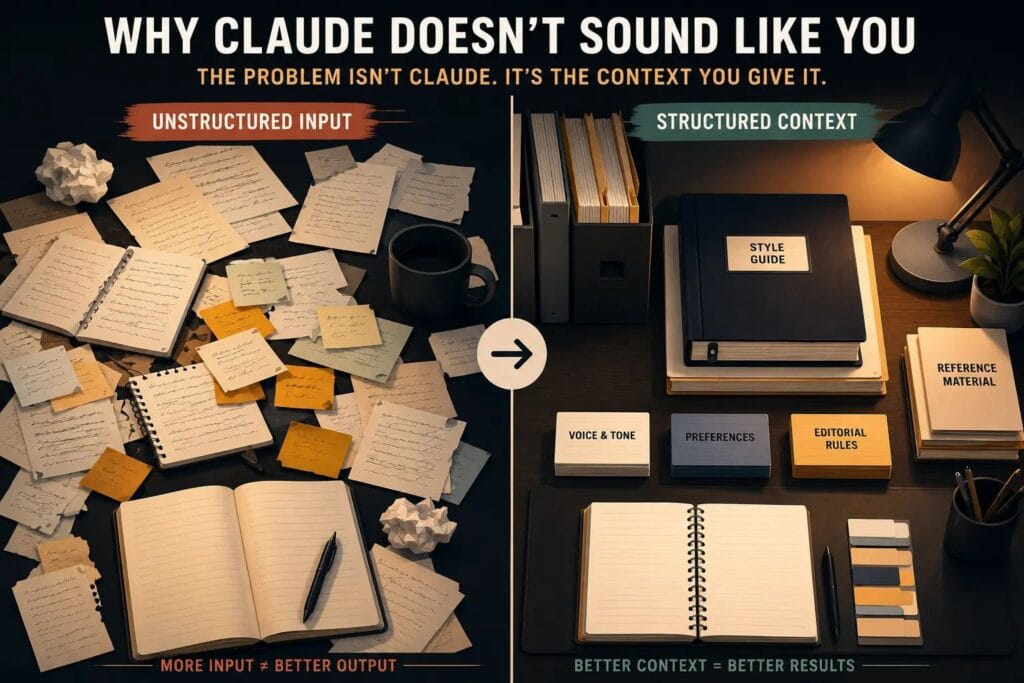
I spent three months rewriting the same prompt. Longer instructions. More examples. A paragraph explaining exactly how I wanted my sentences to sound. Every version came back more polished — and somehow less like me.
I finally figured out the problem wasn’t the prompt. It was everything I wasn’t telling Claude: sentence rhythm, the words I refuse to use, how I open a paragraph, when I break a rule on purpose. None of that lives in a single instruction. Without it, Claude defaults to something smart, competent, and completely neutral.
Quick Answer — Why Doesn’t Claude Sound Like You?
Claude doesn’t have your voice. It has whatever patterns you handed it — a prompt, a sample, an offhand comment about tone. Feed it thin, inconsistent input, and you get thin, inconsistent output back.
| Problem | Actual Cause |
|---|---|
| Sounds generic | No defined writing system |
| Tone changes | Inconsistent context |
| Uses words I’d never write | Missing style guide |
| Different every session | Starting from blank chats |
| Needs heavy editing | No persistent Project structure |
This is one piece of a bigger complete Claude writing system. I explain how everything fits together in my complete Claude for Writers guide, but the short version is this:
Claude doesn’t imitate your writing automatically. It writes from the context you provide—nothing more, nothing less.
The mistake most writers make is assuming there’s a “magic prompt” that unlocks their voice. In my experience, consistency doesn’t come from better prompts. It comes from better documentation.
Mistake #1 — Expecting Claude to Learn Your Voice Automatically
When I started, I dropped two old blog posts into a chat and asked Claude to “write like this.” I expected pattern recognition to do the heavy lifting: feed it my writing, get my writing back.
It doesn’t work that way. Two samples hand Claude surface patterns — sentence length, a handful of word choices. It has no way to know which patterns are deliberate and which are habits I’d cut in editing.
I noticed this after several articles. Claude copied some of my shorter paragraphs but also introduced transition words I’d never intentionally use. It had learned patterns, not preferences. Those are two very different things.
Memory doesn’t solve this either. I’ve explained what Claude actually remembers in detail, and it’s very different from permanently learning your writing voice.. Claude can retain useful context depending on the conversation and how you’ve organized your work, but it doesn’t silently build a complete model of your writing voice over time. Your sentence rhythm, preferred transitions, editorial habits, and banned vocabulary still need to be documented explicitly.
That realization completely changed how I approached AI writing. I stopped trying to teach Claude through repetition and started teaching it through structure.
Mistake #2 — Using Examples Instead of Explicit Rules
Samples show Claude what you’ve written. They don’t tell it what to avoid, what to prioritize, or which of your “mistakes” are actually intentional style choices.
I learned this with transition words. None of my samples used “furthermore” or “additionally,” yet Claude kept introducing them because I’d never explicitly told it not to.
Absence isn’t instruction.
A proper style guide explains things your writing samples can’t:
- Sentence rhythm
- Preferred paragraph length
- Transition style
- Banned words and phrases
- Vocabulary preferences
- Formatting habits
- How you open and close articles
That’s the rulebook behind your writing—not just examples of the finished result.
Once I stopped relying only on samples and started writing explicit rules, the consistency improved far more than it ever had from adding another article as an example.
Mistake #3 — Starting Every Session From Scratch
Every new chat starts cold.
It doesn’t matter how good yesterday’s output was—today’s conversation doesn’t automatically inherit that work unless you’ve created a system that carries the context forward.
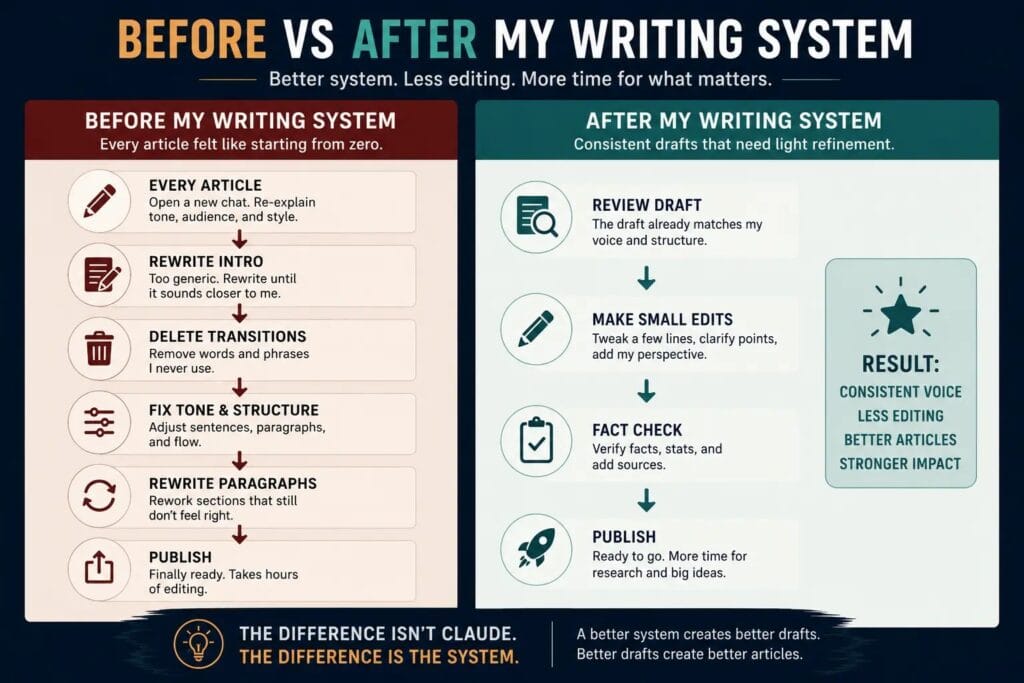
I used to open a fresh conversation for every article. That meant repeatedly explaining my audience, my writing style, and even basic preferences I’d already described dozens of times.
The result wasn’t disastrous—it was inconsistent.
Some articles sounded close to my voice.
Others drifted toward Claude’s default style.
Moving to one Project for each website solved most of that inconsistency because the important context stopped living inside temporary chats and started living inside the Project itself.
That’s the exact structure I explain in How to Set Up Claude Projects for Writers, because organizing the Project correctly matters far more than writing another prompt.
I still begin each writing session with a short recap of today’s task, but I’m no longer rebuilding my entire writing process every time I sit down.
If you’re unsure when to use a Project versus an Artifact, I break down the differences in Claude Projects vs Artifacts for Writers, since they solve two completely different problems
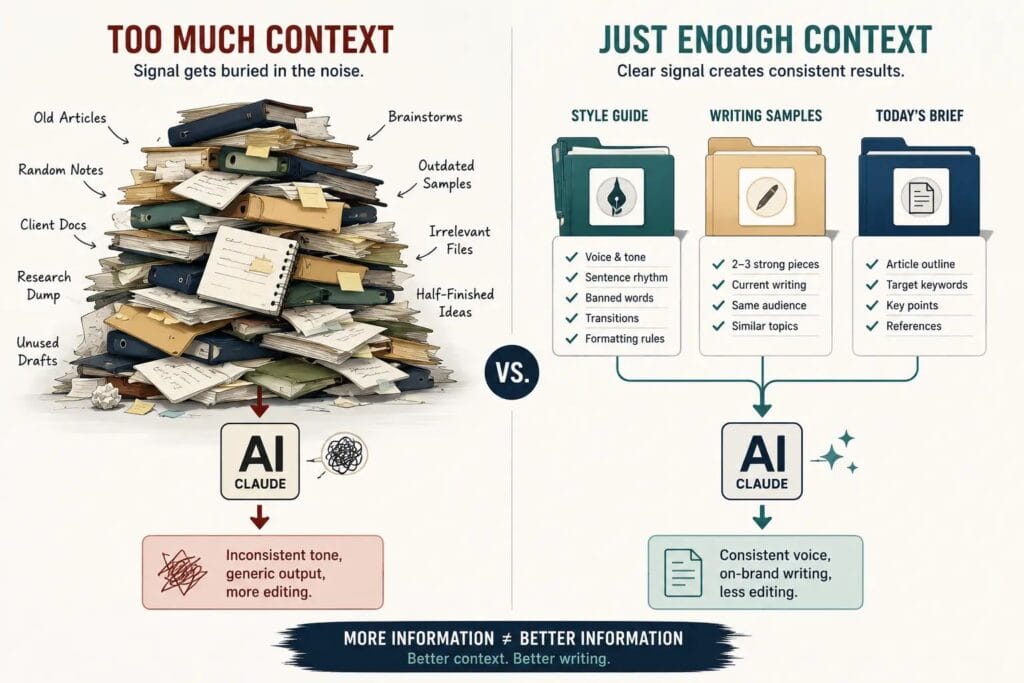
Mistake #4 — Giving Claude Too Much Context
More context feels safer.
It isn’t.
This ended up being one of the biggest surprises in my own workflow.
At one point I treated my Project like a storage folder. Every old article, abandoned draft, research note, brainstorm, and client document went into it because I assumed more information would produce better writing.
The opposite happened.
Claude wasn’t confused because it had too little information.
It had too much.
Some writing samples reflected how I wrote six months earlier. Others belonged to completely different audiences. A few still contained experiments I’d already abandoned.
The result was inconsistent output because the signal was competing with the noise.
Today I separate permanent context from temporary context.
Permanent context includes:
- My style guide
- My strongest writing samples
- Evergreen reference material
Temporary context includes:
- Today’s outline
- Research notes
- Competitor observations
- Sources specific to the current article
That separation made my drafts noticeably more consistent because Claude wasn’t trying to average together dozens of unrelated documents.
More context isn’t always better.
Better context is better.
Mistake #5 — Never Updating the System
This isn’t really a Claude problem.
It’s a documentation problem.
For months I deleted the same phrases from almost every draft.
Every article.
Every week.
Eventually I realized I wasn’t fixing Claude.
I was fixing the same instruction failure over and over again.
Now, whenever I notice a repeated issue—whether it’s overused wording, paragraph structure, or formatting—I update my style guide instead of correcting individual drafts forever.
That single change compounds over time.
Each improvement becomes part of the system instead of another editing task waiting for me tomorrow.
The same idea drives my Claude for SEO Writing workflow. I spend more time improving the system than repeatedly fixing the same writing problems article after article.
Mistake #6 — Asking Claude to Copy Your Voice Instead of Your Decisions
Explain that writers ask Claude to “write like me” instead of documenting how they make writing decisions (paragraph length, transitions, pacing, emphasis, etc.).
Mistake #7 — Expecting Claude to Replace Editorial Judgment
Explain that Claude can follow a style guide, but it can’t decide which story to tell, which section to cut, or what insight is worth emphasizing. That’s still the writer’s job.
The Simple System I Use Today
My writing process now follows one chain:
Research → Claude Project → Style Guide → Knowledge Base → Current Task → Writing Session → Updated Project Files
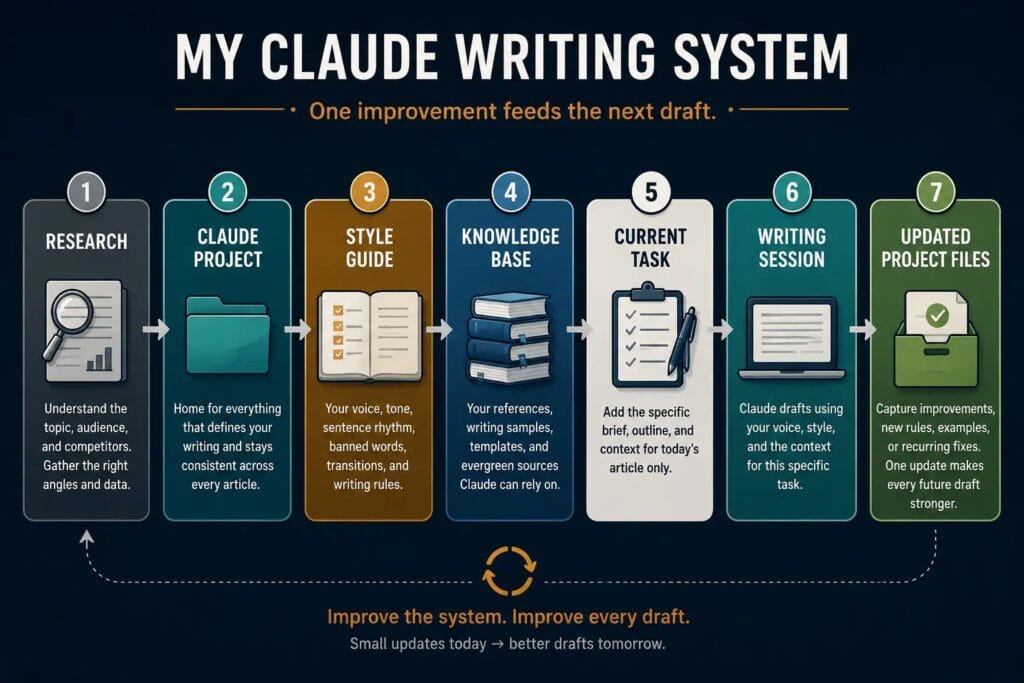
Research happens before Claude ever writes a sentence.
The Project stores what shouldn’t change.
The style guide defines my writing decisions.
The knowledge base gives Claude reliable reference material.
Each writing session stays narrowly focused on today’s article instead of everything I’ve ever written.
Finally, every recurring correction goes back into the Project documents so the next draft starts from a better foundation than the previous one.
That’s the biggest difference in my workflow today.
I’m no longer editing the same mistakes forever.
I’m improving the system that produces the drafts.
How I Knew Claude Finally Sounded More Like Me
There wasn’t one magical moment.
Instead, I noticed a series of small changes.
I stopped deleting the same transition words from every draft.
Introductions needed fewer rewrites.
Paragraph length became more consistent.
The editing process shifted from fixing tone to improving ideas.
Those were the signals that mattered—not because Claude had become me, but because the system around it had become mature enough to produce consistently usable first drafts.
That’s a much more realistic goal than expecting perfect imitation.
Claude Still Won’t Become You
Even with a solid style guide, there are things Claude still can’t do.
It can’t replace your judgment.
It can’t contribute lived experience you haven’t shared.
It can’t decide which personal story genuinely strengthens an argument.
It can’t know when breaking one of your own writing rules makes the article stronger.
Those decisions remain yours.
Claude’s job is to reduce repetitive work—not replace the thinking that makes your writing worth reading.
Every draft still goes through my AI Workflow for Human-Like Blog Posts, where I handle structural editing, voice refinement, fact checking, and the final polish before anything gets published.
I stopped rewriting that prompt eventually. Not because I found the perfect wording—there isn’t one—but because I stopped expecting a single prompt to do the work of an entire writing system.
Claude was never going to guess my voice from two articles and a vague instruction.
No writer’s voice is that simple.
The real breakthrough came when I stopped searching for a better prompt and started documenting how I actually write.
If there’s one lesson I’d leave you with, it’s this:
Build your writing system before you build another prompt.