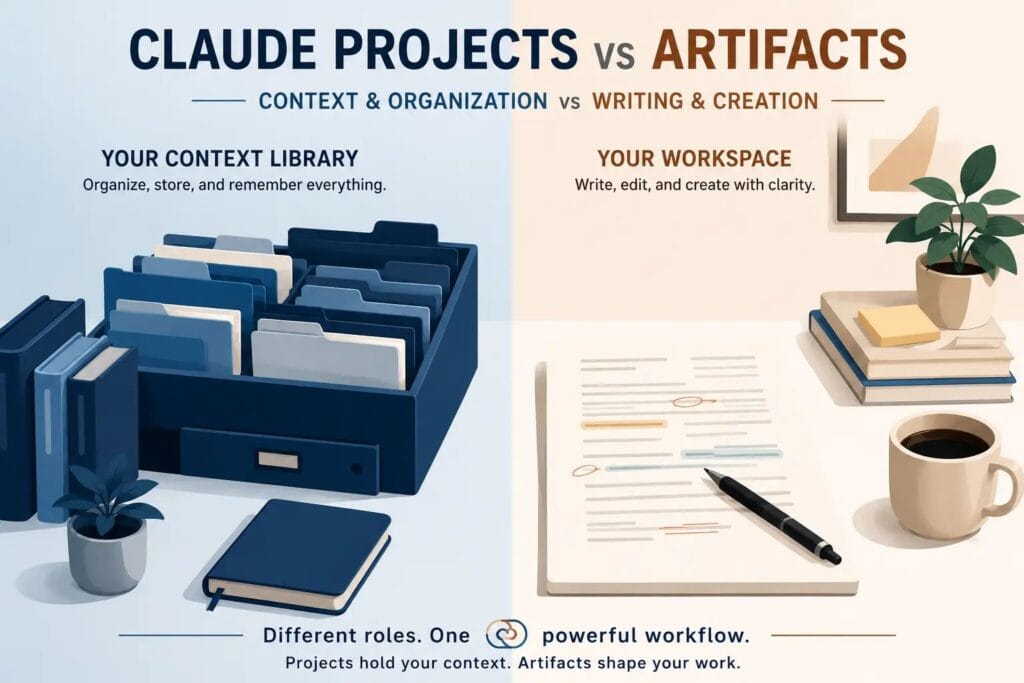
I spent my first few weeks with Claude convinced I had to choose one. Projects or Artifacts. Context layer or document layer. Workspace or draft.
That framing was wrong. Projects and Artifacts aren’t alternatives. They’re sequential — one feeds directly into the other. Once that clicked, a lot of frustration went away.
The short version: Projects hold what Claude needs to know. Artifacts are where the writing actually happens. You need both.
Quick Answer
| Claude Projects | Claude Artifacts |
|---|---|
| Save context and instructions | Create and edit documents |
| Best for ongoing work | Best for drafting and revising |
| Long-term workspace | Working document |
If you’re writing regularly, you’ll get the best results by using both together.
When I Use Projects vs Artifacts
Here’s the sequence I run on every piece:
Research
↓
Claude Project
↓
Outline
↓
Artifact
↓
Editing
↓
Publish
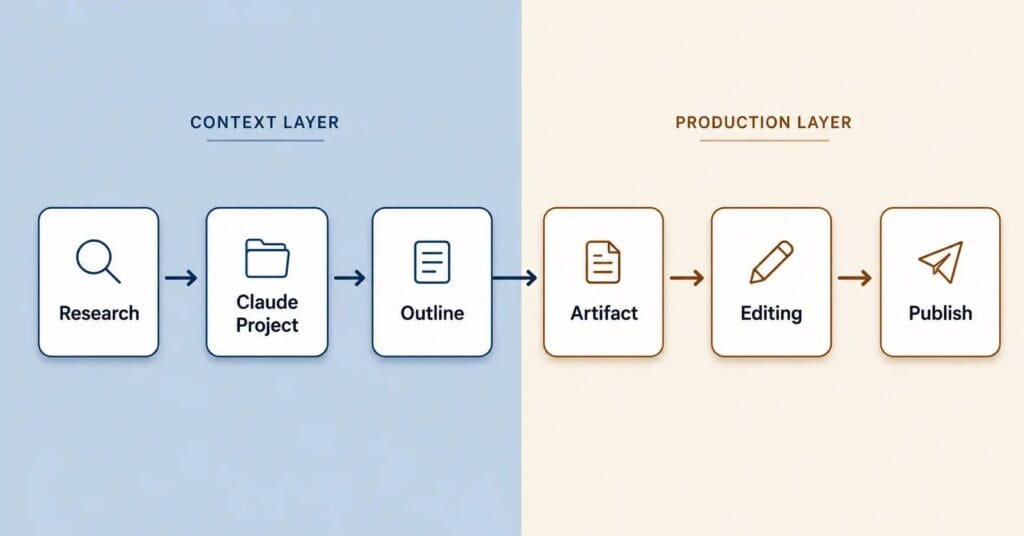
Research first. I gather sources and reference material before I open Claude. The output is only as good as the context going in.
Into the Project. Those references get uploaded to the Project knowledge base — one Project per site, not one per article. My voice samples, style rules, and any past articles I want Claude to reference all live here. The Project instructions tell Claude exactly how to write for this specific site. Full setup is in How to Set Up Claude Projects for Writers: A Step-by-Step Walkthrough.
Outline before drafting. I review the structure inside the Project chat before a single line of the article gets written. A bad outline is a five-minute fix. A bad draft costs an hour.
Open the Artifact. This is where the draft lives. Claude edits the document in place instead of rewriting it in a new message every time I ask for a change. Every version is saved, so I can step back when a revision goes in the wrong direction. The full editing workflow is in How to Use Claude Artifacts for Writing: The Professional’s Editing and Production Guide (2026).
Edit, then publish. Structural edit first — section order, logic gaps, anything that doesn’t belong. Voice edit second — anything that doesn’t sound like me. Final read for facts before it goes live.
The Biggest Mistake I Made
I was creating a new Claude Project for every article I wrote.
Within a month I had dozens of them — each holding a fragment of context with no relationship to anything else. Voice notes scattered here, research scattered there, nothing connected.
The fix: one Project per site. All reference material, style rules, and past articles in one place. Now when I start a new piece, the context is already loaded. I’m not rebuilding it from scratch every session.
The second mistake was editing inside chat. I’d ask Claude for a revision, get a new message back, then manually compare it to the version above. Slow. Error-prone. Easy to miss what actually changed.
Opening an Artifact solved it. Claude revises the document directly, the history is preserved, and I’m not scrolling through a wall of chat messages trying to find which paragraph changed.
Which One Should Writers Choose?
| Writing Task | Projects | Artifacts |
|---|---|---|
| Blog posts | ✓ | ✓ |
| Books | ✓ | ✓ |
| One-off emails | ✓ | |
| Research library | ✓ | |
| SEO articles | ✓ | ✓ |
| Newsletters | ✓ | ✓ |
For anything you write more than once — blogs, books, SEO articles, newsletters — use both.
For a single short piece you’ll never touch again, an Artifact alone is faster. No point building a Project for one email.
For reference material you’ll reuse across pieces, Projects are the only feature that holds it properly. Nothing in an Artifact persists past that document.
One practical note: Projects are available to free accounts (up to five), but memory and the expanded knowledge base are paid-plan features. Worth knowing before you design a whole workflow around it.
For how Projects and Artifacts fit inside a complete SEO workflow — keyword research through publish — I covered the full sequence in Claude for SEO Writing: My Complete Workflow for Creating Search-Optimized Content.
The Takeaway
Projects organize my work. Artifacts improve my work.
Once I understood that distinction, I stopped trying to choose between them. The Project holds everything Claude needs to write well for this site. The Artifact is where the actual writing — and the real editing — happens.
Most writers who feel stuck with Claude output are skipping one of these layers. Either drafting in chat without an Artifact and losing track of revisions, or ignoring Projects and re-explaining their voice from scratch every single session. Neither approach scales.
The full system is in Claude for Writers: The 2026 Operational Guide to Better Writing, Long-Form Projects, and Professional Workflows. Start there if you want the complete picture.