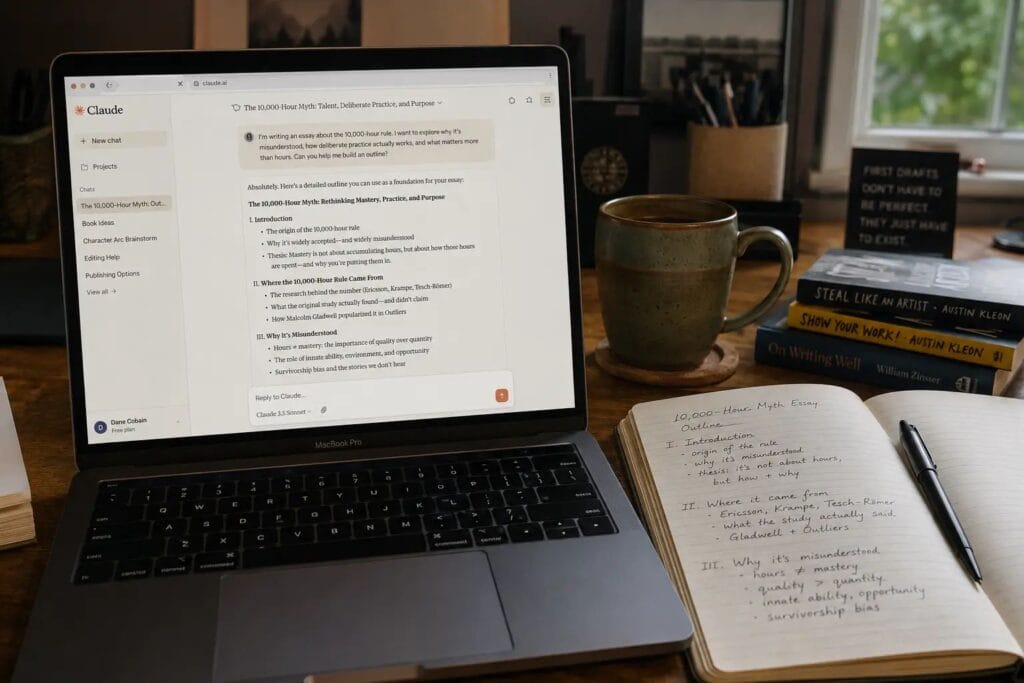
I spent six months trying to make Claude sound like me. I uploaded articles. I pasted in style notes. I wrote long prompt instructions explaining my tone, my sentence length, the way I open sections.
The output improved. But it never felt right.
It was close — the way a cover band is close. All the notes are there. But you can still tell something is missing.
The problem wasn’t Claude. The problem was that I had never actually defined my writing voice. I was handing Claude a pile of writing samples and expecting it to reverse-engineer something I hadn’t bothered to articulate myself.
That changed when I stopped trying to show Claude my voice and started building a Voice Profile first.
The Short Answer: How I Train Claude to Write in My Voice
Here’s the framework, in order:
- Collect writing samples — Pull 5–8 pieces that sound most like you at your best.
- Extract writing patterns — Analyze what makes those pieces yours. Sentence length, paragraph rhythm, how you open, what you refuse to say.
- Build a Voice Profile — Turn that analysis into a short reference document Claude can actually follow.
- Calibrate the output — Test, compare, identify drift, update the profile, regenerate.
Most guides stop at step one. That’s why most results feel like a polished version of generic.
Why Most Claude Voice Training Guides Fall Short
The standard advice is: upload writing samples and tell Claude to match the style.
That’s not wrong. It’s just incomplete.
Claude recognizes patterns. The problem is, when you upload raw samples without explicit guidance, Claude doesn’t know which patterns matter to you. It averages what it sees — including habits you’d want it to ignore.
Consider two different writers. Both write about business strategy. One uses punchy one-liners and keeps every paragraph under three sentences. The other writes long, methodical paragraphs that build a case slowly. Both upload their five best articles. Both say “match the style.”
The output technically reflects patterns from each. But it sounds like neither.
Writing voice isn’t just sentence length. It’s tone, vocabulary preferences, how you signal authority, and — critically — what you refuse to write. Claude needs those patterns made explicit. That’s exactly what a Voice Profile does.
Step 1 – Extract Your Writing DNA
Before I open Claude, I analyze my own writing. I map what I call my writing DNA — the specific patterns that make my work recognizable even without my name attached.
Here’s what I look at:
Sentence Structure
Do I write short, declarative sentences? Long, conditional ones? A deliberate mix? I count average words per sentence across a few representative pieces.
Paragraph Structure
How many sentences per paragraph on average? Do I use single-sentence paragraphs for impact? I do. Often.
Openings
How do I typically start articles and sections? I open with observations or specific scenarios — never definitions, never statistics I didn’t earn through direct experience.
Tone
Am I conversational? Clinical? Direct? I’m direct, occasionally blunt, and I write like I’m talking to someone I respect — not someone I’m trying to impress.
Vocabulary Preferences
Which words do I reach for naturally? Which ones make me wince? My writing DNA includes an explicit banned list — words that signal generic AI output the moment they appear.
Authority Signals
How do I build credibility? Through specific client examples, documented failures, and real numbers. Not by citing research I’ve never tested myself.
Once I’ve mapped this, I have the raw material for a Voice Profile.

Step 2 – Build a Voice Profile
This is the step most writers skip. It’s also the most important one.
A Voice Profile is a short reference document — one to two pages — that describes how I write. Not what I write about. How.
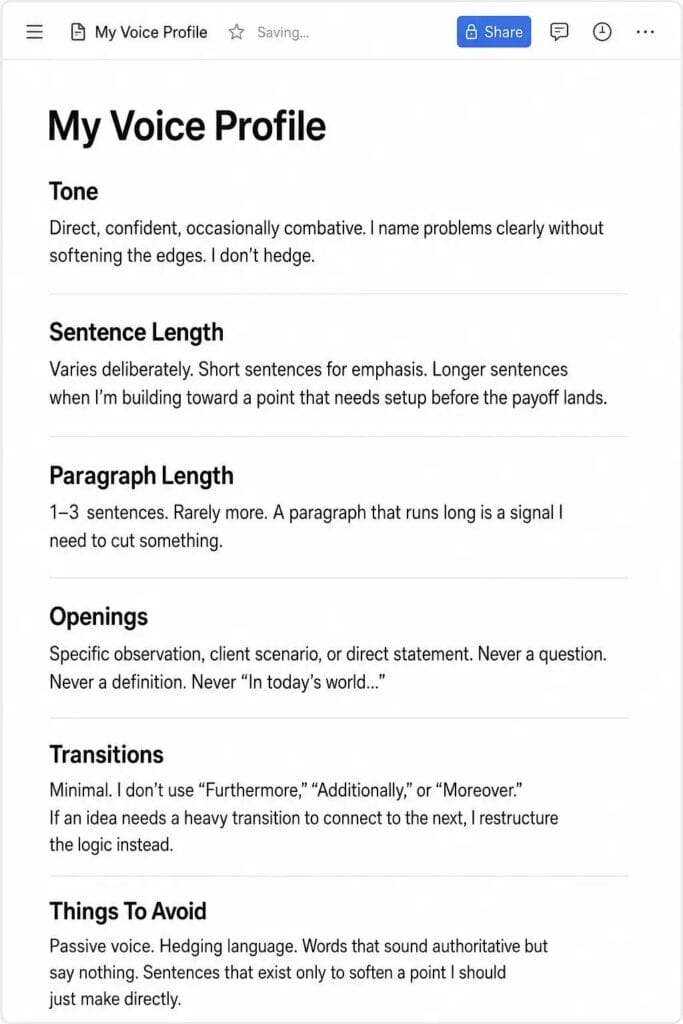
Here’s what mine includes:
Tone: Direct, confident, occasionally combative. I name problems clearly without softening the edges. I don’t hedge.
Sentence Length: Varies deliberately. Short sentences for emphasis. Longer sentences when I’m building toward a point that needs setup before the payoff lands.
Paragraph Length: 1–3 sentences. Rarely more. A paragraph that runs long is a signal I need to cut something.
Openings: Specific observation, client scenario, or direct statement. Never a question. Never a definition. Never “In today’s world…”
Transitions: Minimal. I don’t use “Furthermore,” “Additionally,” or “Moreover.” If an idea needs a heavy transition to connect to the next, I restructure the logic instead.
Things To Avoid: Passive voice. Hedging language. Words that sound authoritative but say nothing. Sentences that exist only to soften a point I should just make directly.
That last section is the one most people skip entirely. Telling Claude what not to do is often more effective than describing what to do. Give it explicit prohibitions and it has far less room to fill gaps with defaults.
Step 3 – Train Claude Using Projects and Writing Samples
Now I bring in Claude.
I use Claude Projects for all my voice training work. Projects let me maintain persistent context across conversations — I’m not re-explaining my style from scratch every session.
My project setup:
- Project instructions: A compressed version of my Voice Profile. Tone rules, structural preferences, the banned vocabulary list.
- Writing samples: 5–8 pieces that represent my current voice. Current matters. I don’t include old work from an earlier phase of my writing.
The combination is what makes the difference. Writing samples show Claude what I’ve done. The Voice Profile tells Claude which parts to replicate and which parts to ignore.
The mechanics of setting up Claude Projects are covered in detail in my Claude for Writers guide. My focus here is strategy: the Voice Profile is the instruction manual. The samples are the training data. You need both — and the Voice Profile needs to come first.
Step 4 – Calibrate Outputs and Prevent Voice Drift
Here’s something most guides never mention: voice drift.
Voice drift happens when Claude’s output gradually becomes less consistent with your actual writing. It’s not one catastrophic failure. It’s a slow slide — a slightly different word here, a sentence structure you’d never use there. Over time, the gap quietly widens.
The usual causes:
- Instructions that are too vague
- Writing samples that send conflicting signals
- Prompts mid-project that introduce new stylistic information
- A Voice Profile built once and never updated
My calibration workflow:
Draft → Compare → Identify Differences → Update Voice Profile → Generate Again
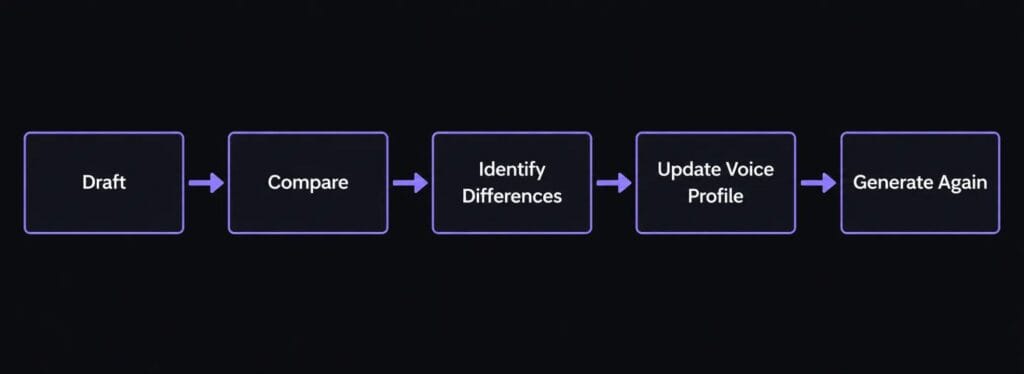
If you want to run this entire calibration loop inside Claude — tracking drafts, comparing versions, keeping revision notes in one place — my Claude Artifacts guide covers exactly that workflow.
I don’t just tell Claude “this doesn’t sound like me” and ask for a redo. I identify the specific differences, trace them to a gap in my instructions, update the profile, and regenerate. That way I’m fixing the system — not patching a single output.
A Real Example From My Testing
Claude kept opening sentences with “Furthermore,” “Additionally,” and “Moreover.”
I never use those transitions. My writing moves from one idea to the next through logic and structure. Not connective tissue.
The problem wasn’t Claude. My Voice Profile described what I do. It said nothing about what I don’t.
I added one line: “Use minimal transitions. Do not use ‘Furthermore,’ ‘Additionally,’ or ‘Moreover.’ If a transition feels necessary, restructure the paragraph instead.”
The output changed immediately.
Not because Claude suddenly understood my voice at some deeper level — but because I gave it a clear, specific instruction it could actually follow. Specificity always beats vagueness. The more precisely you define your writing DNA, the less room there is for Claude to fill gaps with generic defaults.
Common Mistakes When Training Claude
- Uploading weak writing samples — Pieces that don’t represent your best or most consistent work
- Mixing styles from different phases — Including articles from five years ago alongside your current writing
- Vague instructions — “Sound casual and engaging” tells Claude almost nothing actionable
- Skipping calibration — Building a Voice Profile once and never updating it after testing
- Copying someone else’s voice guide — A borrowed template cannot capture your specific writing DNA
The Takeaway
The biggest mistake isn’t failing to train Claude. It’s failing to define your own voice clearly enough for Claude to follow.
Most writers treat this as a Claude problem. It isn’t. It’s a clarity problem. Claude can only reproduce what you’ve actually articulated. If your voice exists in your head but not on paper, no AI tool in the world can extract it for you.
Build the Voice Profile first. Upload the samples second. Calibrate continuously.
That’s the sequence that produces output which actually sounds like you.