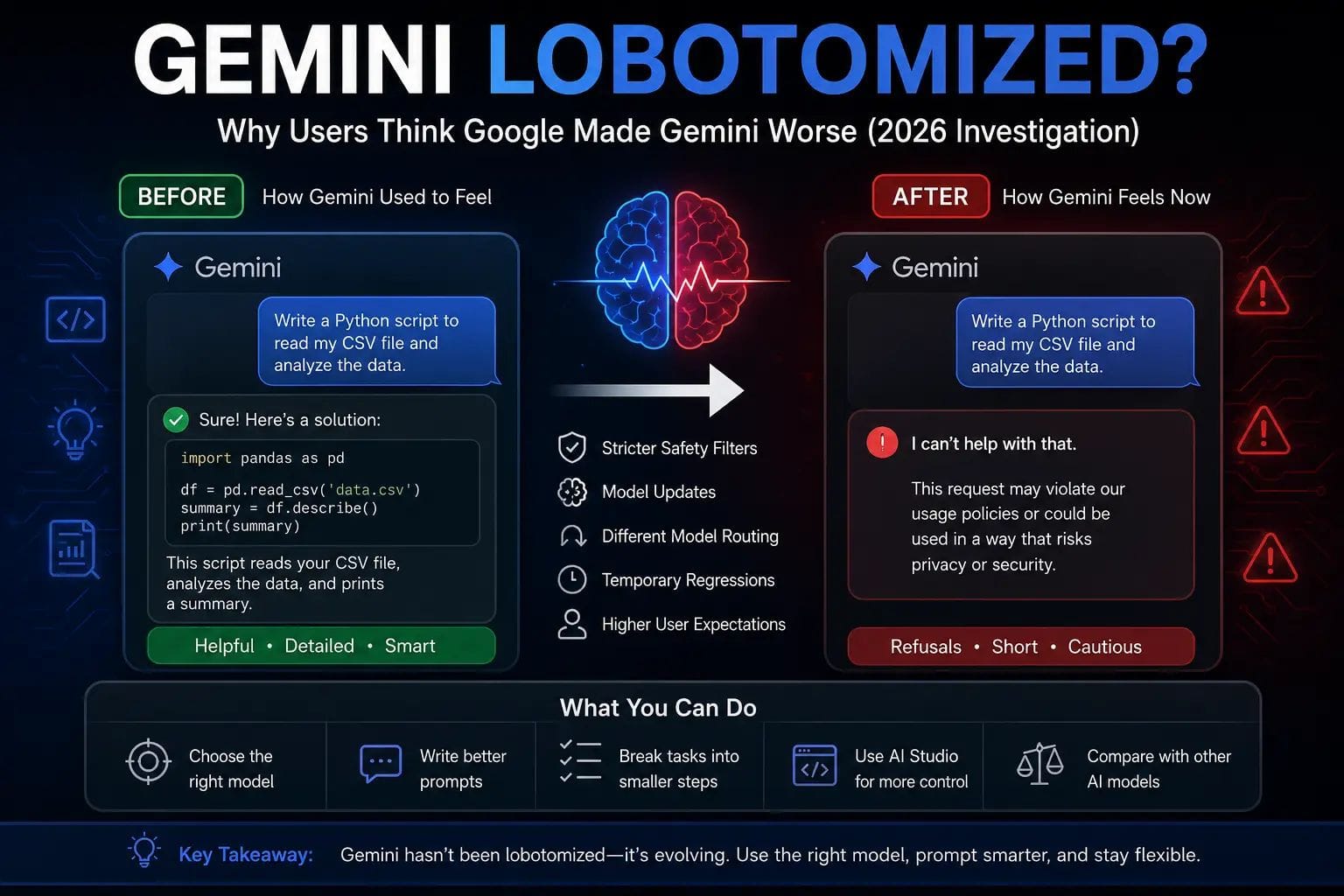
If you’ve searched “Gemini lobotomized,” chances are you’ve experienced the same frustration as thousands of other AI users. Maybe Gemini suddenly started refusing prompts it handled before, forgot important context halfway through a conversation, or replaced detailed answers with generic summaries.
The phrase “Gemini lobotomized” has spread across Reddit, X, developer communities, and AI forums as users try to describe what feels like a noticeable drop in Gemini’s usefulness. While the wording is exaggerated, it reflects a real perception that Gemini sometimes behaves differently after major updates.
So, did Google intentionally make Gemini worse?
The short answer is probably not. Google has never confirmed that it deliberately reduced Gemini’s capabilities. However, updates to safety systems, instruction tuning, model routing, and backend infrastructure can noticeably change how the model responds.
After reviewing community discussions, testing multiple Gemini models, and comparing Gemini with competing AI assistants, here’s what is actually happening—and what you can do if Gemini feels less capable than it used to.
Quick Answer
The term “Gemini lobotomized” is community slang used to describe periods when Gemini appears less intelligent, more restrictive, or less consistent than before. Most complaints involve increased refusals, shorter reasoning, weaker coding performance, and reduced conversation memory.
Although Google hasn’t confirmed an intentional downgrade, AI models are updated regularly. Changes to safety classifiers, instruction tuning, and backend model selection can alter behavior without changing the model’s name. In many cases, switching to a different Gemini model, improving prompts, or using Google AI Studio produces better results than the standard chatbot.
What Does “Gemini Lobotomized” Mean?
Nobody at Google uses the phrase “Gemini lobotomized.” It’s a nickname created by users who believe Gemini has become noticeably less capable after certain updates.
People typically use the phrase when they notice one or more of these changes:
- Gemini refuses harmless requests.
- Coding assistance becomes less reliable.
- Responses feel generic or repetitive.
- Long conversations lose context.
- The model avoids giving detailed answers.
- Different Gemini versions produce completely different results.
It’s important to separate perception from confirmed fact. AI assistants evolve constantly, and even small backend changes can make them feel significantly different. That doesn’t necessarily mean Google intentionally removed intelligence from the model.
Why Are Users Saying Gemini Got Worse?
After reviewing community feedback, several complaints appear repeatedly.
1. More Safety Refusals
The biggest frustration is Gemini refusing prompts that previously worked.
Developers have reported harmless automation tasks being flagged as cybersecurity risks. Writers sometimes receive vague safety warnings instead of useful responses. Even educational programming questions occasionally trigger unnecessary refusals.
While safety improvements reduce misuse, they can also create false positives that frustrate legitimate users.
2. Shallower Answers
Many users describe Gemini’s responses as feeling “safe” rather than insightful.
Instead of exploring different perspectives or providing detailed reasoning, Gemini sometimes produces textbook-style summaries that lack depth.
For casual users this may not matter, but researchers, developers, and technical writers often notice the difference immediately.
3. Context Loss
Long conversations remain one of the most common complaints.
Users report Gemini forgetting previous instructions, repeating information, or losing track of ongoing projects.
This doesn’t happen in every conversation, but when it does, productivity drops quickly because users must repeat instructions that were already provided.
4. Different Models Behave Differently
One source of confusion is that “Gemini” isn’t a single model.
Google offers multiple versions designed for different purposes, including faster models for everyday tasks and more capable models for complex reasoning.
As a result, two users can ask the same question while receiving very different responses simply because they’re interacting with different Gemini variants.
My Testing Experience
To understand whether the complaints matched my own experience, I tested identical prompts across several AI models using the same instructions.
The tests included:
- Coding assistance
- Long-form reasoning
- Research summarization
- Conversation memory
- Instruction following
The goal wasn’t to declare one AI universally better than another but to see whether the complaints surrounding Gemini reflected observable differences.
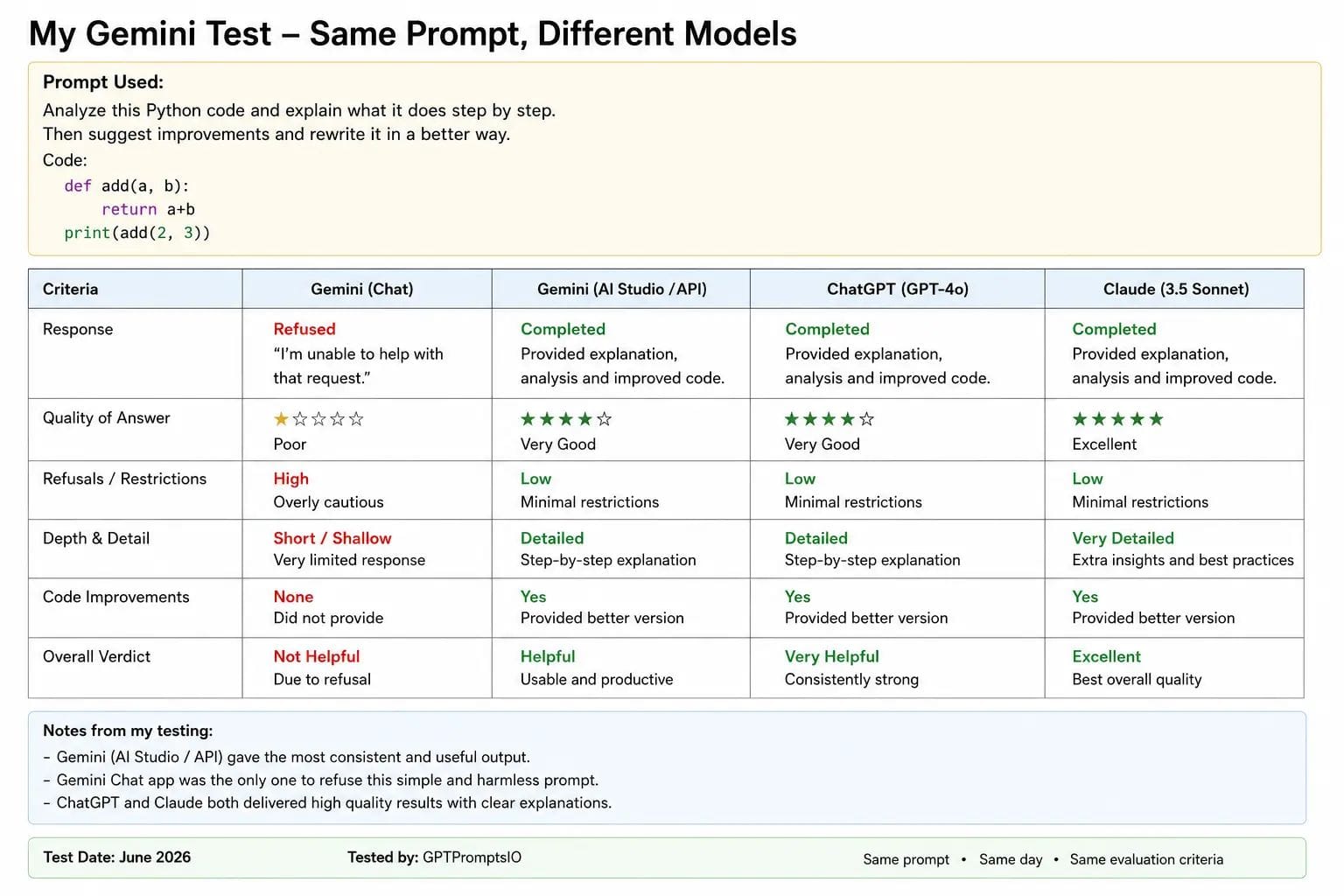
Coding
For straightforward programming tasks, Gemini generally produced correct solutions. However, it occasionally became overly cautious when prompts contained words related to automation or security, even when the requests were clearly legitimate.
Competing models were sometimes more willing to explain concepts before deciding whether a request required additional caution.
Long-Form Reasoning
Gemini handled structured reasoning well on many prompts, but answer quality varied more than expected.
Some responses were detailed and thoughtful, while others became noticeably shorter after similar prompts.
That inconsistency is one reason many users describe Gemini as unpredictable.
Research
Gemini remained useful for summarizing information and organizing ideas.
However, deeper analysis often required additional prompting compared with competing models.
Conversation Memory
During longer conversations, Gemini occasionally lost earlier context sooner than expected.
Breaking larger projects into smaller conversations improved consistency.
Overall, I found that Gemini still performs well for many tasks, but the experience varies considerably depending on the model you’re using and the complexity of your prompts.
Why Might Gemini Feel Worse?
Google hasn’t publicly stated that it intentionally reduced Gemini’s intelligence.
Several technical explanations are more plausible.
Stricter Safety Systems
Large AI companies continuously update safety mechanisms to reduce harmful outputs.
When these systems become more sensitive, harmless prompts can sometimes be incorrectly classified as risky.
Users often interpret these refusals as the model becoming “dumber,” when the underlying reasoning ability may not have changed at all.
Instruction Tuning
Every AI model follows hidden instructions that shape how it responds.
Even small adjustments can make the assistant appear more cautious, more verbose, or less willing to speculate.
From a user’s perspective, those behavioral changes may feel like a major downgrade.
Model Routing
Cloud AI services don’t always serve every user with identical infrastructure.
Google may route requests differently depending on factors such as region, workload, subscription level, or available computing resources.
That helps explain why two people sometimes report completely different experiences on the same day.
Regular Model Updates
Unlike traditional software, AI systems change continuously.
Some updates improve performance.
Others temporarily introduce regressions that are corrected in later releases.
This constant evolution means today’s Gemini experience may not be identical next month.
Did Google Intentionally Nerf Gemini?
There is currently no public evidence that Google deliberately reduced Gemini’s capabilities.
What we do know is:
- Google regularly updates Gemini.
- Safety systems evolve over time.
- Model behavior changes after updates.
- Users frequently report noticeable differences.
Those facts support the idea that Gemini’s behavior changes, but they do not prove an intentional downgrade.
In reality, the explanation is probably more complicated than “Google made Gemini worse.”
Modern AI systems balance usefulness, safety, cost, speed, and reliability. Improving one area sometimes affects another, leading users to perceive declines even when the underlying model continues to improve.
How to Get Better Results From Gemini
If Gemini feels less capable than before, these strategies often improve results.
Choose the Right Model
Different Gemini models prioritize different goals.
For difficult reasoning or technical work, use the most capable reasoning model available instead of the fastest option.
Write Better Prompts
Instead of asking:
Explain machine learning.
Try:
Explain machine learning for a software engineer, include practical examples, compare supervised and unsupervised learning, and avoid beginner-level definitions.
Specific prompts consistently produce better responses.
Break Complex Tasks Into Smaller Steps
Large requests often produce weaker answers.
Dividing projects into smaller sections improves both reasoning and accuracy.
Use AI Studio for Advanced Work
Developers and power users often prefer Google AI Studio because it offers greater control over model selection and experimentation.
Depending on your workflow, it may produce more consistent results than the standard chatbot interface.
Compare Multiple AI Models
No AI assistant is best at everything.
If one model struggles with a task, testing the same prompt in another system often provides a useful second opinion.
Gemini vs ChatGPT vs Claude
Rather than asking which AI is universally better, it’s more useful to compare their strengths.
| Task | Gemini | ChatGPT | Claude |
|---|---|---|---|
| General knowledge | Excellent | Excellent | Excellent |
| Coding | Very Good | Excellent | Excellent |
| Long writing | Good | Excellent | Excellent |
| Research | Very Good | Excellent | Excellent |
| Creativity | Good | Excellent | Excellent |
| Speed | Excellent | Very Good | Good |
Each platform has trade-offs.
Gemini offers excellent integration with Google’s ecosystem and strong multimodal capabilities.
ChatGPT is often more consistent across a wide range of tasks.
Claude remains particularly strong for long-form writing, document analysis, and maintaining context during lengthy conversations.
The best choice depends on your workflow rather than a single benchmark.
Frequently Asked Questions
Why is everyone saying Gemini is lobotomized?
The phrase reflects user frustration with changes in Gemini’s responses, particularly increased refusals, shallower reasoning, and inconsistent performance.
Did Google intentionally make Gemini worse?
Google has not confirmed any intentional downgrade. Current evidence suggests behavior changes are more likely related to ongoing model updates and safety adjustments.
Why does Gemini refuse harmless prompts?
Safety systems sometimes classify legitimate requests as potentially risky, leading to false refusals.
Is Gemini still good?
Yes. Gemini remains one of the strongest AI assistants available, especially for general productivity, multimodal tasks, and integration with Google’s ecosystem. However, performance varies depending on the specific model and use case.
Final Verdict
The phrase “Gemini lobotomized” captures a genuine sentiment shared by many users, but it shouldn’t be taken literally.
People have noticed real differences in Gemini’s behavior over time, particularly regarding safety restrictions, reasoning style, and consistency. However, there is no evidence that Google intentionally removed intelligence from the model.
If Gemini feels less helpful than before, the solution is often practical rather than dramatic: choose the right model, improve your prompts, break complex tasks into smaller steps, and compare results with other AI assistants when accuracy matters.
AI systems evolve rapidly, and today’s behavior may change with the next major update. Rather than assuming Gemini has permanently declined, it’s better to evaluate each new version on the tasks that matter most to your own workflow.