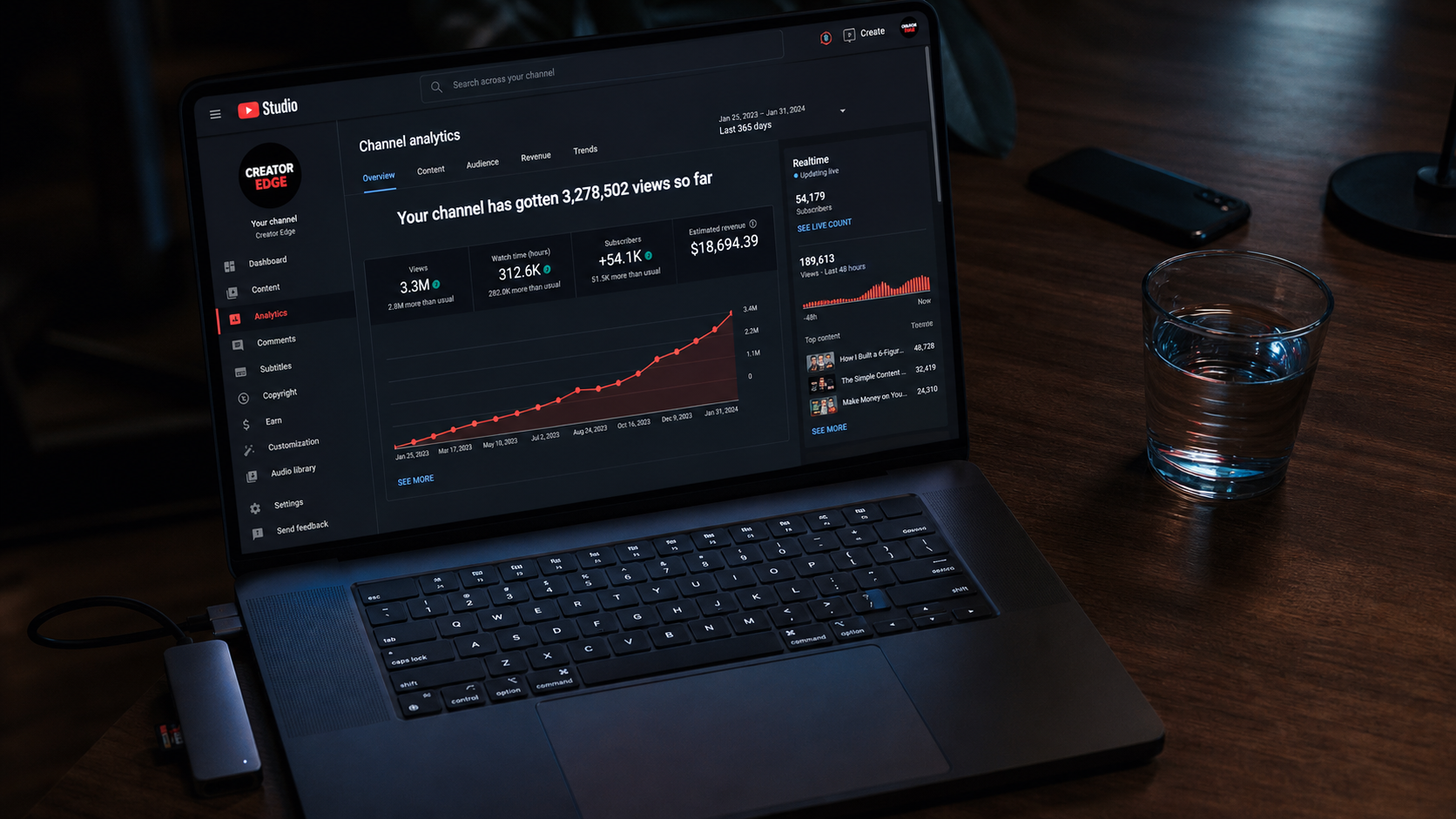
The Reality Check Nobody Gives You
Every week, someone publishes a guide telling you YouTube automation is a passive income machine you can set up in a weekend.
They are not lying exactly. They are just leaving out the part where in January 2026, YouTube wiped out 4.7 billion views in a single enforcement wave sixteen channels with a combined 35 million subscribers lost everything overnight.
And the part where one creator invested $26,311 over 150 days and lost nearly $10,000.
This guide covers both sides. What the model actually is, what it actually costs, what YouTube actually penalizes now, and critically what is still working for faceless channels in 2026. If you are a freelancer, student, or digital business owner trying to build a real income stream without showing your face on camera, this is the most honest breakdown you will find.
No hype. No $97 course upsell at the end.
What YouTube Automation Actually Is (And What It Is Not)
YouTube automation also called running a “faceless channel” or a “cash cow channel” means building a content operation where you never appear on camera and never personally record your voice.
The workflow looks like this:
- You identify a profitable niche and content angle
- AI tools or freelancers handle scripting, voiceover, and editing
- You manage the strategy, quality control, and publishing decisions
- The channel earns through AdSense, affiliate links, and brand deals
The key word in that last point is manage Noah Morris reportedly runs over 25 automated faceless channels, earning an estimated $200,000+ per month total but this is not a “set it and forget it” situation. He runs it like a media company, with systems for research, production, quality control, and optimization. It is a full-time business operation.
That distinction matters more in 2026 than at any previous point in YouTube’s history. The channels getting terminated are not the ones using AI. They are the ones using AI as a replacement for creative judgment rather than as a tool that serves it.
The January 2026 Enforcement Wave: What Actually Happened
In January 2026, YouTube demonetized thousands of channels for uploading AI-generated content. But it is not all doom and gloom the platform is filtering out “AI slop”: low-effort, repeatable content that earns money without human input. Instead of hitting individual videos, YouTube now evaluates whole channels to find these creators faster.
The YouTube inauthentic content policy a quiet rename of the old “repetitious content” rules started with a July 2025 expansion that broadened the definition from “repetitive uploads” to “content lacking genuine human creativity.” Smaller enforcement actions followed through late 2025. Then came January 2026, the largest mass channel termination of AI-driven channels in YouTube’s history.
What got channels terminated:
- AI-only slideshows: static AI-generated images moving with no real narration or editing effort
- Template clones: videos that are identical in everything but the title or character name
- Overposting: no human can post 12 times per day with no variation it gives away automation instantly
- No-value content: faceless compilations with zero commentary or a static image background
What is explicitly still allowed:
YouTube officially clarified that faceless channels are not banned only low-effort, mass-produced ones are targeted. AI narration is allowed. AI-assisted editing is allowed. What is not allowed is using AI to mass-produce content with no original thought, research, or creative direction.
The line YouTube draws: if you use AI to organize your topic and then add your own script, narration, and examples, YouTube welcomes it. If you type one sentence into an AI tool and publish the output without checking or improving it, YouTube sees it as low-effort automation.
One more critical requirement: YouTube’s AI disclosure rule has been mandatory since 2024 and is enforced more strictly in 2026. You must toggle the “Altered or synthetic content” setting in YouTube Studio for every video that uses AI-generated content. Skipping this is a terms of service violation, not just a courtesy.
What YouTube Automation Channels Realistically Earn in 2026
Before you plan a business around this model, you need real numbers not income screenshots from someone selling a course.
RPM by niche (verified March 2026 creator dashboard data):
| Niche | RPM Range | Competition Level |
|---|---|---|
| Personal Finance | $10–$15 | High |
| Make Money Online | $13.52 average | High |
| Betrayal & Revenge Narratives | $12.82 | Low–Medium |
| True Crime Documentaries | $8–$13 | Medium |
| Animated Educational Storytelling | $9–$13 | Medium |
| Soundscapes for Sleep | $10.92 | Low |
| Senior Health & Longevity | $6–$12 | Very Low |
| Motivational Content | $5–$9 | High |
| YouTube Shorts (all niches) | $0.01–$0.06 | — |
The highest CPM YouTube niches in
2026 are personal finance ($15–$22 CPM), make money online ($15–$20 CPM), legal/court drama ($12–$18 CPM),
digital marketing ($12–$18 CPM), and real estate ($10–$16 CPM).
However, CPM alone does not determine profitability competition levels, audience size, and content format all matter.
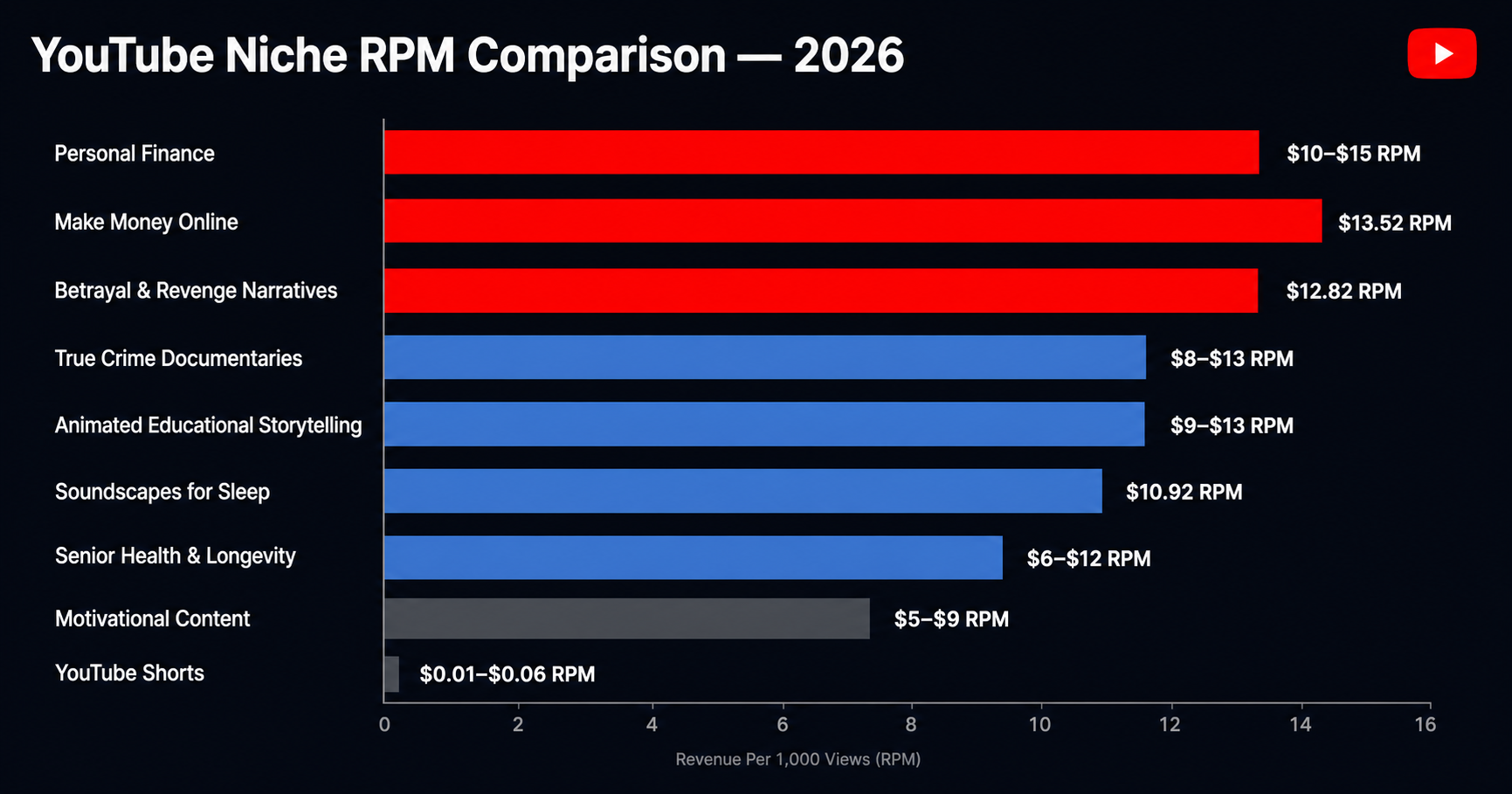
That Shorts RPM figure deserves a separate callout. Shorts RPM sits at just $0.01–$0.06 per 1,000 views useful for channel growth but not for revenue. Long-form content still earns significantly more ad revenue than Shorts in 2026, with videos over 8 minutes hitting the sweet spot for mid-roll ad placements that can double or triple RPM.
Realistic income timeline:
Most well-executed channels take 6–12 months to reach the monetization threshold of 1,000 subscribers and 4,000 watch hours. Initial payouts are typically $50–$500 per month, scaling to $500–$5,000 per month by months 12–18 for channels that have found their format.
One documented creator earned $9 in their first four days after hitting the YouTube Partner Program threshold. Hardly life-changing but it shows the typical early-stage reality. Most creators earn almost nothing in their first months, even after hitting the YPP threshold.
The actual production cost nobody mentions upfront:
Channels using freelance scriptwriters upload 12–15 videos monthly versus just 3–4 for solo creators at costs of $100+ per video that drain budgets before monetization kicks in 6–24 months later.
Expect to invest $200–$2,000 per month in production costs before seeing any return. If you are starting with $500 total, do not outsource. Use AI tools to reduce per-video cost significantly and invest the savings in niche research instead.
The 2026 Tool Stack: What to Use and Why
These tools are evaluated for their current usefulness, not for affiliate commission potential.
| Category | Tool | Cost | Honest Assessment |
|---|---|---|---|
| Scriptwriting | ChatGPT Plus | $20/mo | Strong for structure; weak for voice. Always rewrite in your own tone. |
| Scriptwriting | Claude | Free / $20 Pro | Better nuance for long-form scripts. Use for full draft, then edit. |
| Voiceover | ElevenLabs | $5–$22/mo | Most realistic AI voices available. Use the “turbo” model for consistency. |
| Voiceover | Murf AI | $19–$39/mo | Better for corporate/educational tone. Less natural for storytelling. |
| Video Assembly | Pictory | $19–$99/mo | Best for script-to-video automation. Weak on custom visuals. |
| Video Assembly | CapCut Desktop | Free | Most versatile free option. Manual work required. |
| Thumbnail Design | Canva Pro | $10/mo | Still the most practical option for non-designers. |
| SEO Research | VidIQ | Free / $7.50+/mo | Most actionable keyword data for YouTube-specific research. |
| SEO Research | TubeBuddy | Free / $4.50+/mo | Better for A/B testing titles and thumbnail variants. |
| Clip Finding | Opus Clip | $15/mo | Genuinely useful for repurposing long-form into Shorts for growth. |
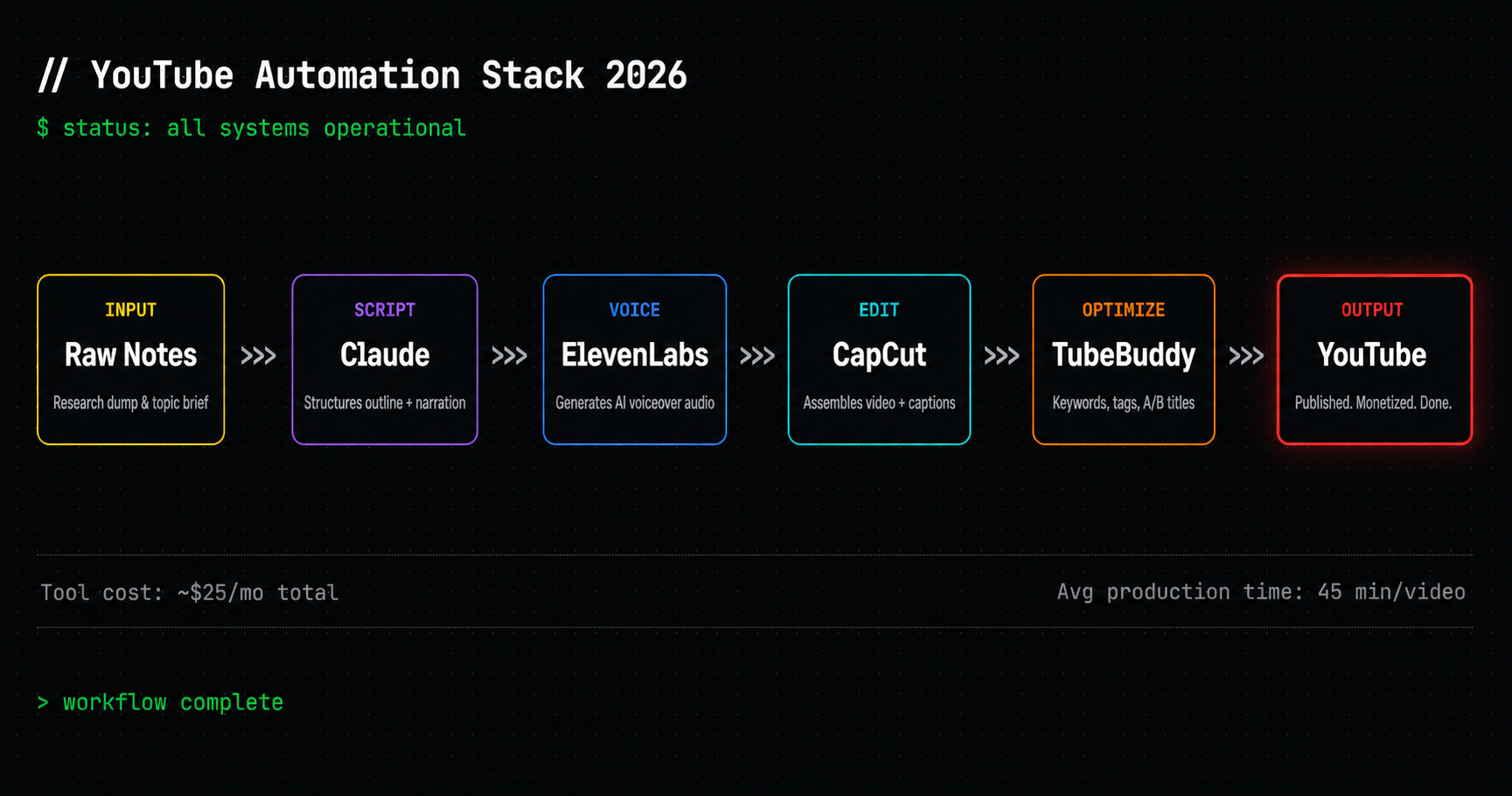
One tool combination that reduces production cost dramatically: Use Claude to write a detailed script from a research brief you provide, then paste it into ElevenLabs for voiceover, then drop both into CapCut for editing. Total tool cost under $25 per month. Production time per video: 2–3 hours for a beginner, 45 minutes once you have the workflow memorized.
How to Pick a Niche for a Faceless YouTube Channel in 2026
This is where most beginners lose months of effort. Niche selection is not about passion. It is about the intersection of four specific factors:
1. Advertiser demand (CPM)
High-CPM niches pay significantly more per 1,000 views. A finance channel at $12 RPM earns 4x more than a general entertainment channel at $3 RPM from the same view count. Choose a niche where advertisers have something expensive to sell.
2. Format suitability for faceless production
The best faceless niches combine high advertiser demand with formats that do not require an on-camera host: finance explainers, true crime documentaries, tech tutorials, meditation and sleep content, educational animations, and data-driven storytelling.
3. Competition density
Low-competition, high-demand niches in 2026 include literary analysis ($9.15 RPM, only 10,000 competing channels), senior health and longevity ($6.17 RPM with 19x growth), veteran kindness stories ($7.13 RPM, 14x growth), and soundscapes for sleep ($10.92 RPM, only 20,000 channels). These are not saturated. They are underserved.
4. Your ability to add genuine editorial judgment
This is the factor that determines whether your channel survives the inauthentic content policy. If you have no actual interest in or knowledge of a niche, you cannot add the layer of human creative direction that YouTube now requires. You will produce template content. Template content gets terminated.
The practical test: Before committing to a niche, write ten video ideas without using AI. If you struggle to get past three, you do not have enough domain knowledge to differentiate your content. Pick a different niche.
The Step-by-Step Workflow for Starting a Faceless YouTube Channel
Week 1–2: Foundation
- Choose your niche using the four-factor framework above
- Analyze the top 20 performing videos in that niche. Look at titles, thumbnail styles, video length, and the first 60 seconds of each. Take notes manually this research shapes your entire content strategy
- Set up your channel with a clear name, professional banner (Canva), and a description that uses your target keywords naturally
- Create a content calendar for your first 12 videos
Week 3–4: First Video Production
The Script Structuring Prompt (The 2026 Standard):Never ask AI to write a script from scratch. Provide a raw data dump and use this exact constraint prompt to force high-retention pacing:
I am providing you with a raw data dump and my rough notes on [Topic]. Do NOT write a generic YouTube script. Instead, act as an elite YouTube retention strategist. Organize this raw data into a video outline using the following constraints:
1. The Hook (0:00–0:30): Open with a jarring statistic or counter-intuitive claim from my notes. No “Welcome back to the channel” fluff.
2. The Payoff (0:30–1:00): Tell the viewer exactly what system or answer they will have by the end of the video.
3. The Body (1:00–8:00): Break the notes into 3 distinct chapters. End each chapter with an open loop — a question or teaser — that forces them to keep watching the next chapter.
Format the output as a two-column table: [Audio/Narration] and [Visual/B-Roll Directives].
- Generate voiceover using ElevenLabs. Listen to the full output. Edit every line where the pronunciation or pacing sounds robotic
- Edit the video in CapCut. Add text overlays, relevant b-roll or stock footage, chapter markers, and end screens
- Design a thumbnail in Canva. Use high-contrast colors, minimal text (under 4 words), and a clear focal image
- Enable the “Altered or synthetic content” disclosure in YouTube Studio before publishing
Month 2–3: Consistency and Iteration
- Publish 2 videos per week minimum. Consistency is a ranking signal
- Review your analytics weekly. Track average view duration if viewers are dropping off before the 40% mark, your script structure or pacing is the problem, not the niche
- Test different thumbnail styles using TubeBuddy’s A/B feature once you have enough views to generate meaningful data
- Reply to every comment in the first 48 hours after publishing. Early engagement signals quality to the algorithm
Month 4–6: Monetization Push
- YouTube monetization in 2026 requires 1,000 subscribers and 4,000 watch hours in the past 12 months, or 10 million Shorts views in 90 days, plus compliance with all YouTube policies and a linked AdSense account
- Add affiliate links to relevant products in every video description before you hit monetization. You can earn affiliate revenue without being in the YouTube Partner Program
- Begin building your email list through a simple lead magnet relevant to your niche. AdSense is one revenue stream. It should not be your only one
Month 7+: The AI Dubbing Multiplier (Horizontal Scaling)
Once your English channel is generating consistent views, stop grinding out more English videos. The 2026 meta is horizontal scaling.
ElevenLabs’ AI video dubbing now lets you translate a top-performing video into Spanish or Portuguese in under an hour cloning the original pacing, syncing lip movement to the new language, and automatically adjusting the background audio track to sit under the dubbed narration. No re-scripting. No re-recording. No additional editing hours.
The play: take your five highest-retention English videos and launch a dedicated Spanish-language channel with them as your foundation. Latin American YouTube audiences are significantly less saturated than English-speaking markets, CPMs are rising year-over-year, and your content is already proven to retain viewers. You are not starting from zero. You are cloning a validated system into a market that has not seen it yet.
How to Make Money Beyond AdSense
The channels that survived demonetization best were the ones with diversified income streams. Smart creators treat YouTube as a distribution channel that drives traffic to their actual business: email lists, courses, communities, software products, brand deals, affiliate income. Build your email list.
This is the most important paragraph in this entire guide.
Affiliate marketing for faceless YouTube channels:
One creator with under 6,000 subscribers was earning $190 per month from affiliates alongside $973 in AdSense. The affiliates required no additional production work just strategic product placement and honest recommendations.
Finance channels promote investing apps, budgeting tools, and financial courses. Tech channels promote software, gadgets, and hosting services. Sleep content channels promote mattress brands, supplements, and meditation apps. Every niche has affiliate programs. Find them at Impact.com, ShareASale, or directly through brand websites.
Sponsorships for faceless channels:
Even faceless channels can land sponsor deals once you have consistent views. Brands care about audience fit and engagement, not whether you are on camera. One creator reported getting 1–2 sponsorship offers per week with a channel under 10,000 subscribers in a business niche. The key is building an email list of interested brands and pitching them directly, rather than waiting for them to find you.
Digital products The High-Ticket Asset Play:
Faceless channels in the business and tech niche should not be selling $7 PDF guides. The real leverage is building one premium digital asset and turning every published video into a permanent sales engine for it. The execution looks like this: build a high-value, interactive Notion workspace something like The Author’s Claude Protocol, a structured system that walks creators through building an AI-assisted content operation price it at $50 to $150, and funnel every viewer directly to it via a pinned comment on every video you publish. No ad spend. No launch window. No algorithm dependency. The asset exists once. Every new video that ranks adds another permanent entry point into the same funnel. This is how a faceless channel in the business niche becomes profitable at 200 subscribers rather than waiting 12 months to clear the YPP threshold. AdSense is a reward for scale. A well-positioned digital product is revenue from day one.
The Mistakes That Get Channels Terminated (Not Just Penalized)
Uploading at inhuman frequency. Twelve videos per day is not a content strategy. It is a pattern that YouTube’s detection system flags immediately. No human can post twelve times per day with no variation it gives away AI instantly. Three to five videos per week is aggressive enough to grow and human enough to survive.
Using the same production template across every video. Template clones videos that are identical in everything but the title or character name are explicitly targeted by YouTube’s 2026 inauthentic content policy. Vary your structure, your intro format, your b-roll style.
Relying entirely on AI for scripting with zero editorial input. YouTube wants clear proof that a human participated in the process. If you type one sentence into an AI tool and publish the output without checking or improving it, YouTube sees it as low-effort automation.
Building everything on AdSense with no backup revenue. Channels earning $30,000 per month have been stripped of monetization overnight. If AdSense is your only income stream, you are one policy change away from zero revenue.
Ignoring the disclosure requirement. YouTube requires creators to clearly disclose if their content has been generated or significantly altered using AI technologies. The policy specifically targets realistic AI content that could mislead viewers. Toggle the disclosure. Every video. No exceptions.
The Honest Bottom Line
YouTube automation is a real business model in 2026. Faceless channels now represent 38% of all new creator monetization ventures, up from 12% in 2022. The infrastructure is better, the tools are cheaper, and the playbook is more documented than at any previous point.
But the bar has risen significantly. The channels that survive and monetize are the ones that use a hybrid method: AI for speed, human for originality, opinion, structure, and creative soul.
If you treat this as a passive income button, you will spend money, waste months, and potentially lose the channel entirely.
If you treat it as a media business one that requires genuine editorial judgment, consistent quality standards, and diversified revenue from day one you are building something that compounds over time.
The difference between those two approaches is not talent or luck.
It is whether you actually understand what you are building.