Introduction: Why Most “Editing” Prompts Ruin Books
I have a confession to make: The first time I tried to use AI to edit my novel, it didn’t just fail it ruined my writing.
I didn’t get a polished draft. I got a sanitized, corporate memo that stripped away every ounce of personality I had spent weeks crafting. It was grammatically perfect, and completely soulless.
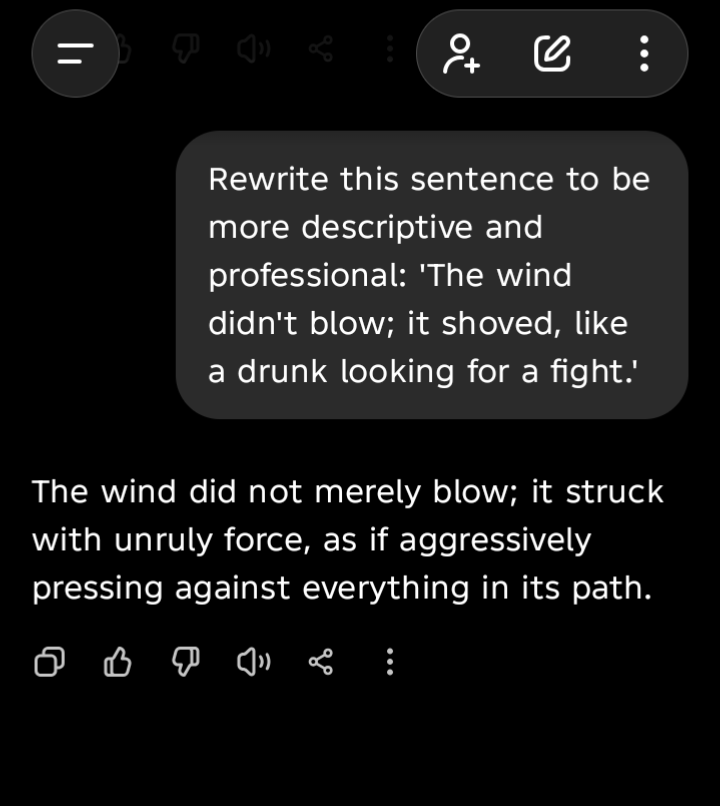
The Evidence (Look at this disaster):
- My Original Line: “The wind didn’t blow; it shoved, like a drunk looking for a fight.”
- ChatGPT’s “Fixed” Version: “The wind did not merely blow; it struck with unruly force, as if aggressively pressing against everything in its path.”
That is the dirty secret most “AI for authors” guides won’t tell you. Standard prompts like “fix the grammar” or “make this flow better” act like a bulldozer to your voice. In creative writing, “grammatically correct” usually means “boring.”
But I refused to give up. Over the last 3 months, I spent $300+ on API credits stress-testing hundreds of variations in Claude 3.5 Sonnet and GPT-4o to find a way to get the technical polish of a professional editor without losing the human spark.
The Result: The “Negative Constraint” Protocol.
This list works because it doesn’t just tell the AI what to do it tells it exactly what NOT to do. If you are looking for the best prompt to edit a book that respects your unique voice, you are in the right place.

Phase 1: The Clean-Up
Best ChatGPT Prompt to Edit Book Chapter: The Clean-Up Phase
When I start editing a fresh draft, I don’t want the AI to rewrite my story. I just want it to clean up the mess I made while writing fast. For this, I use specific ChatGPT prompts for proofreading that act like a spellchecker on steroids catching errors without touching my style.
1. The “Invisible” Proofreader:
Best for: Fixing errors without killing the vibe.
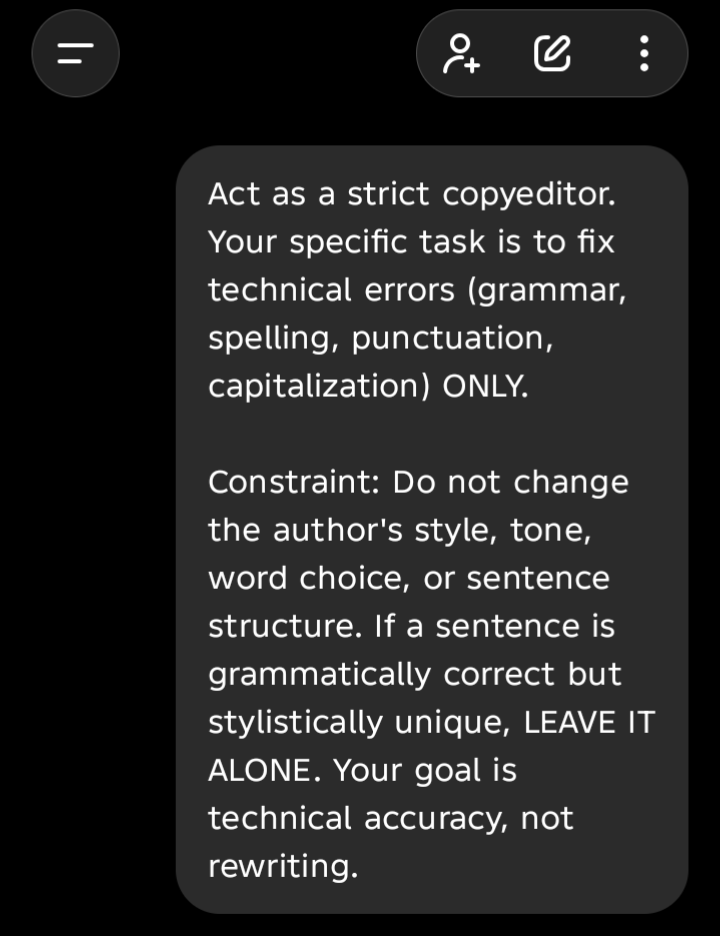
Act as a strict copyeditor. Your specific task is to fix technical errors (grammar, spelling, punctuation, capitalization) ONLY.
Constraint: Do not change the author’s style, tone, word choice, or sentence structure. If a sentence is grammatically correct but stylistically unique, LEAVE IT ALONE. Your goal is technical accuracy, not rewriting.
2. The Consistency Check
Best for: Making sure the narrator doesn’t sound like two different people.
This is one of the most vital tone consistency AI prompts in my arsenal. It ensures my narrator doesn’t switch from a gritty detective to a polite librarian halfway through the chapter.
Analyze this text for continuity errors in Tense, Voice, and Tone. Highlight or fix instances where the narrative voice shifts unintentionally (e.g., slipping from formal to casual, or past to present tense).
Constraint: Ignore shifts that occur in dialogue only fix the narration.
3. Flow & Transition Smoother
Best for: Fixing “choppy” writing.
If you need prompts to improve book flow, this is the one. I use this when I’ve pasted two scenes together and the transition feels jagged.
Edit the following text to improve Flow and Rhythm. Smooth out abrupt transitions between sentences and paragraphs so the ideas connect logically.
Constraint: Do not merge paragraphs unless necessary. Keep the original meaning and pacing intact; just make the reading experience frictionless.
Phase 2: Deep Editing & Logic:
Claude Prompts for Editing Entire Book Draft: Flow & Logic
For deeper structural work, I prefer Claude because it has a larger context window (it can remember more of the story). When I’m doing heavy book editing with AI tools, I switch to these prompts to tighten the prose without losing the plot.
4. The “Clarity” Line Edit
Best for: Untangling messy sentences.
Perform a line-edit focused strictly on Clarity. Identify sentences that are confusing, ambiguous, or overly convoluted, and rewrite them to be direct and precise.
Constraint: Do not “dumb down” the vocabulary. Maintain the author’s sophistication, but remove the confusion.
5. The Publishing Polish
Best for: Making it sound professional.
I use this when I want AI prompts to refine manuscript sections that feel a bit amateurish.
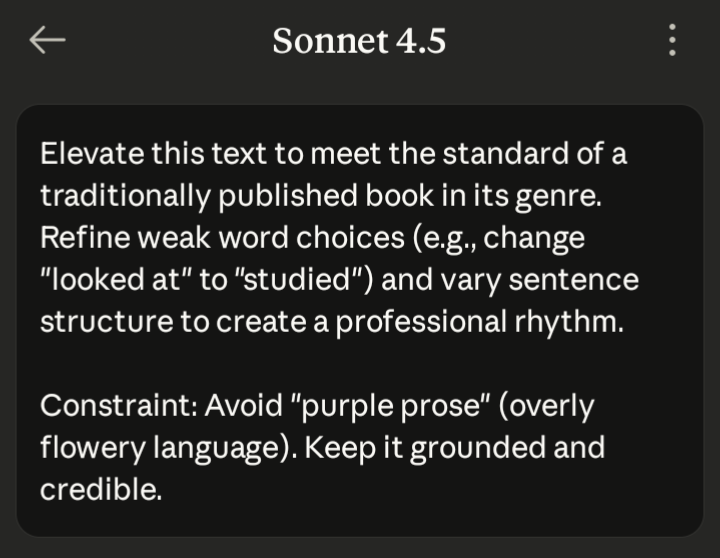
Elevate this text to meet the standard of a traditionally published book in its genre. Refine weak word choices (e.g., change “looked at” to “studied”) and vary sentence structure to create a professional rhythm.
Constraint: Avoid “purple prose” (overly flowery language). Keep it grounded and credible.
6. Logic & Plot Hole Detector
Best for: Finding gaps before your readers do.
Review this text for Internal Logic. Identify contradictions, circular arguments, or timeline errors. If premise A contradicts premise B later in the text, flag it or fix it to maintain continuity.
Constraint: Do not rewrite the argument/plot, just ensure it makes sense internally.
7. Active Voice Injection
Best for: Making the writing punchy.
Scan for Passive Voice and Weak Verbs (was, were, has been). Convert them to Active Voice where it makes the sentence stronger and more direct.
Constraint: Leave passive voice if it is being used for specific emphasis or rhythm. Do not force active voice if it makes the sentence sound unnatural.
8. Paragraph Architect
Best for: Fixing walls of text.
Review paragraph structure. Ensure every paragraph focuses on ONE main idea. If a paragraph drifts into a second topic, split it. If a sentence doesn’t support the paragraph’s main idea, remove or relocate it.
Constraint: Ensure the transition between the new split paragraphs is smooth.
Phase 3: The Final Polish
Effective AI Prompts for Book Proofreading & Final Polish
Once the story is solid, I move to the final stage. This is where I use prompts to fix grammar in my novel and remove the fluff that usually sneaks into a first draft.
9. The “Fluff” Cutter
Best for: Reducing word count.
Remove Redundancy and Filler Words. Cut phrases that repeat information already stated (e.g., “he nodded his head” -> “he nodded”).
Constraint: Do not cut descriptions or adjectives that add atmosphere/flavor. Only cut words that serve zero purpose.
10. Emotional Resonance
Best for: Fiction scenes or persuasive copy.
This is arguably one of the best prompts for story editing because it focuses on feeling, not just grammar.
Audit the “Emotional Temperature” of this scene. Ensure the language matches the intended emotion (e.g., if the scene is sad, ensure the pacing is slower and words are heavier). Adjust phrasing to maximize emotional impact.
Constraint: Do not veer into melodrama. Subtlety is better than exaggeration.
11. The “Bird’s Eye” Review
Best for: Checking a whole chapter.
Analyze this chapter as a standalone unit. Does it have a clear Beginning, Middle, and End? Does the ending hook the reader for the next chapter? Provide a bulleted list of structural weaknesses, if any.
12. The “White Glove” QC
Best for: The absolute last step.
These are the essential proofreading prompts for authors just before hitting publish.
Simulate a final Quality Control pass. Look specifically for: typo clusters, missing words, accidental double spaces, and homophone errors (their/there) that spellcheckers miss.
Constraint: Do not make any stylistic changes at this stage. Pure error hunting only.
Advanced Strategy
Top Prompts for Book Structure and Clarity
If you are self-publishing, you might not have the budget for a human Beta Reader. You can simulate one using prompts for novel beta reading.
Bonus Prompt: The “Ruthless Critic”
“Read this chapter from the perspective of a bored reader who hates plot holes. Tell me exactly where you started to lose interest and which characters feel inconsistent. Be harsh.”
I have found that using grammar check prompts for novels is easy, but getting AI to critique your structure requires you to give it permission to be mean. This feedback loop is essential for clarity.
Frequently Asked Questions
Can I rely solely on AI book editing prompts?
No. While these are the AI book editing prompts I trust, they are tools, not replacements. Always do the final read-through yourself.
Which AI is better for editing?
For short sections, ChatGPT is faster. For analyzing large chunks of text, I recommend Claude prompts for editing entire book draft sections because Claude has a more natural, human-like writing style out of the box.
Are these prompts safe for non-fiction?
Yes. Whether you are writing a thriller or a business book, the principles of clarity and negative constraints apply universally.