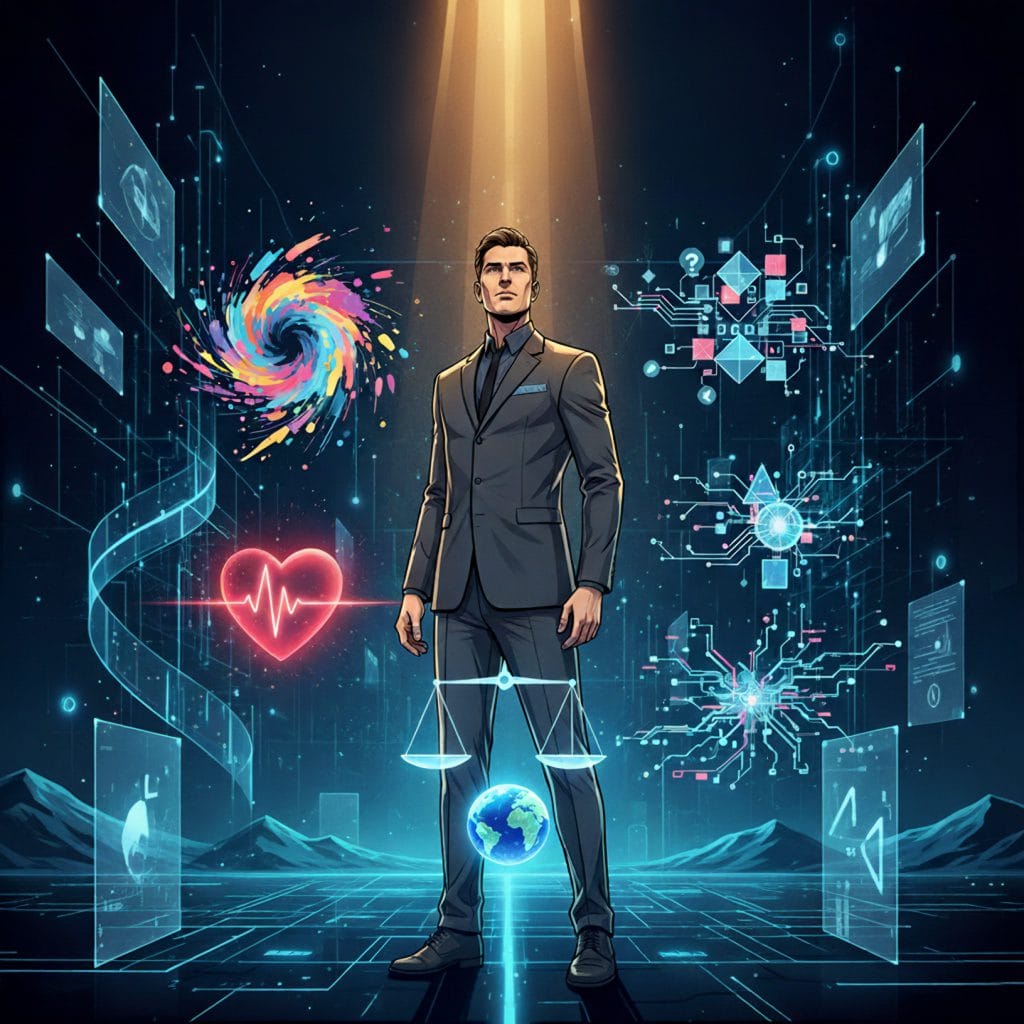
The Human Edge in the Age of Artificial Intelligence:
In 2026, the conversation around artificial intelligence has shifted from fascination to friction. As automation accelerates from OpenAI’s GPT models redefining knowledge work to humanoid robots entering factories the question haunting professionals isn’t what AI can do, but what’s left for us.
Yet amid this wave of disruption, a paradox is emerging. The very technologies designed to replicate human intelligence are inadvertently amplifying the value of the traits that machines can’t replicate creativity, empathy, ethical judgment, and strategic foresight.
While AI systems can generate perfect code, compose symphonies, or draft legal documents in seconds, they still stumble on context, meaning, and moral nuance. This signals a critical turning point: success in the next decade won’t depend on outsmarting algorithms, but on mastering distinctly human capabilities.
Below, we explore five core skills where humans continue to outpace even the most advanced AI and why these traits will define the future of meaningful work.
1. Emotional Intelligence: The New Competitive Advantage:
AI may recognize faces, but it still struggles to read feelings. Emotional intelligence (EQ) the ability to understand, interpret, and influence emotions has become one of the rarest and most valuable professional currencies in the digital economy.
According to a 2024 McKinsey report, roles that require high emotional engagement like leadership, healthcare, counseling, and customer success are among the least likely to be automated by 2030. The reason is simple: empathy can’t be programmed.
For instance, while chatbots can handle routine support tickets, top companies like Salesforce and Zappos still rely heavily on human agents for complex interactions where tone, patience, and understanding drive customer loyalty. Similarly, in healthcare, the rise of “AI diagnostic assistants” has not reduced the need for nurses or therapists it’s enhanced their roles by freeing time for genuine human connection.
As automation handles repetitive work, the ability to listen, respond, and connect is becoming the cornerstone of modern leadership. This shift signals a broader truth: in an age of artificial intelligence, emotional intelligence is the ultimate differentiator.
2. Creativity: Where Algorithms End and Imagination Begins:
Generative AI can remix the past, but it can’t dream of the future. Tools like Midjourney and ChatGPT have democratized creativity, yet they also highlight its limits AI produces variations of what already exists, while human creators redefine what’s possible.
In 2026, brands from Nike to Pixar are doubling down on human led creative direction. For example, Nike’s “Human Touch” campaign last year combined AI generated visuals with real athlete stories crafted entirely by human storytellers who understood cultural nuance and emotion.
Industry leaders predict that the next creative boom won’t come from replacing designers or writers but from augmenting them. A 2024 Adobe study found that 72% of creative professionals using AI reported higher output but also increased pressure to develop “original human ideas” that stand apart from algorithmic sameness.
This signals a crucial evolution: as AI floods the world with content, authenticity, vision, and taste become the new creative currency. The ability to surprise, provoke, and inspire remains uniquely and unshakably human.
3. Critical Thinking and Judgment: The Trust Gap in Automation:
AI systems excel at pattern recognition, not judgment. In sectors like finance, law, and journalism, this distinction is becoming increasingly important as algorithms take on more decision-making roles.
Consider the case of Goldman Sachs, which uses machine learning to optimize trading strategies but still relies on human analysts for risk assessment and ethical oversight. The same goes for courts experimenting with AI-assisted sentencing tools judges continue to serve as the ultimate arbiters of fairness.
The challenge lies in what experts call the “trust gap.” As AI decisions become more complex, humans must interpret, question, and sometimes override the output. A 2026 Stanford AI Lab survey found that 68% of professionals express “moderate to low trust” in AI-driven judgments that lack explainability.
This signals a future where critical thinking isn’t just a skill it’s a safeguard. Those who can blend data-driven insights with ethical reasoning will remain indispensable as industries navigate the grey areas of machine intelligence.
4. Adaptability: Thriving Amid Constant Reinvention:
In a world where technology evolves faster than job titles, adaptability has become the new form of intelligence. Every major labor study from the World Economic Forum to PwC converges on the same finding: the most valuable workers are not those with the most technical skills, but those who can learn, unlearn, and relearn continuously.
The pandemic accelerated this trend, but AI has cemented it. Consider Microsoft’s internal “AI fluency” program, launched in 2024, which retrained over 200,000 employees in prompt engineering, data ethics, and automation tools. The goal wasn’t technical mastery it was resilience.
We may see a new era of “portfolio careers,” where professionals move fluidly across disciplines, blending soft and technical skills to remain relevant. Industry leaders predict that adaptability will be the defining trait of the 2030 workforce one where job descriptions evolve as fast as the technologies they support.
The message is clear: in the age of AI, agility is not optional it’s existential.
5. Ethical Foresight: The Moral Compass of Technology:
Perhaps the most irreplaceable human skill of all is moral judgment. As AI systems shape hiring, healthcare, policing, and even democracy, the question isn’t only what they can do but what they should do.
This has given rise to a new professional frontier: AI ethics. From OpenAI’s “Red Teaming Network” to Google’s Responsible AI division, companies are actively hiring ethicists, sociologists, and philosophers to anticipate unintended consequences.
For example, when IBM paused facial recognition research in 2024 citing potential bias, it wasn’t a technical failure it was an ethical decision led by humans. Similarly, policy makers across Europe and Asia are drafting AI regulations centered on fairness, transparency, and accountability domains that no algorithm can self-govern.
Ethical foresight demands moral imagination, cultural sensitivity, and long-term thinking traits that define humanity itself. In the race to automate everything, this human compass may prove to be our most essential innovation.
The Future: A Symbiosis, Not a Showdown:
The rise of AI isn’t a story of replacement it’s one of realignment. As algorithms absorb analytical and operational tasks, humans are being pushed upward into roles demanding intuition, empathy, and ethics.
We may see a future workforce defined less by technical specialization and more by human synthesis: people who can collaborate with machines, interpret ambiguity, and shape technology toward social good.
Industry leaders predict that by 2035, every major company will rely on a new class of professionals “AI-literate humans” who act as translators between computational logic and human values.
The broader message is both sobering and hopeful. AI will continue to transform industries, but the essence of work creativity, compassion, and conscience remains uniquely ours.
As automation redefines productivity, it also reminds us what makes us irreplaceable. The future of work won’t belong to the smartest machinesbut to the most human minds guiding them.